Direct from manufacturing lines: Fully traceable precision studs, structural assemblies, concrete expansion anchors, and forged pressure retaining components tested to international standards.
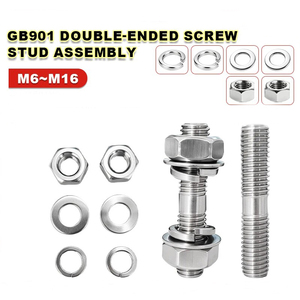
Precision GB901 dual-threaded rod sets equipped with anti-loosening lock washers and hex nuts. Solution-annealed austenitic steel for sanitary, chemical, and offshore structural duty.
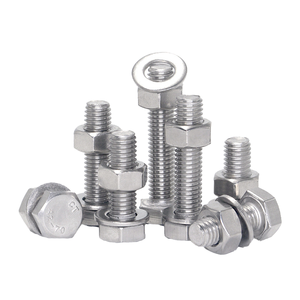
Full-thread hex cap screws with precision mating DIN 934 nuts and flat washers. Certified dimensional accuracy across M9, M10, M12, and M14 for machinery mounting and pipeline support frames.
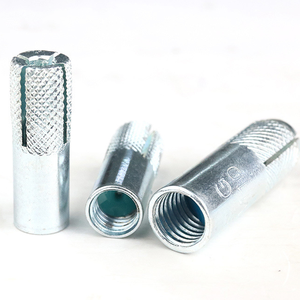
Solid internally-threaded flush anchors for anchoring lifting eye bolts, suspended piping, and cable trays into uncracked concrete foundations. Cold-formed alloy core prevents thread distortion.
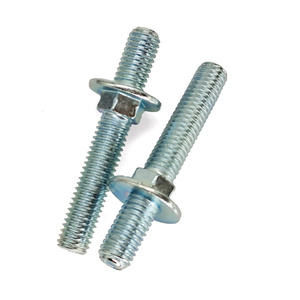
Carbon and low-alloy steel double-end studs engineered with rolled coarse or fine threads. Passivated zinc coating exceeds 120-hour salt spray benchmarks without dimensional thread interference.
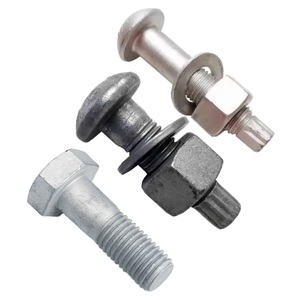
ASTM F3125 Grade F1852 / F2280 structural preloaded assemblies for civil bridge frames and heavy crane runways. Calibrated spline shears off when accurate clamp load is attained.
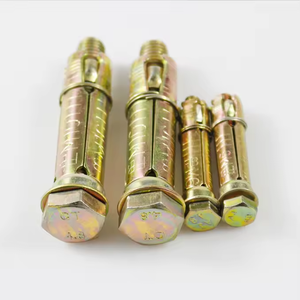
Four-segment expanding rawl shield fasteners designed for high-vibration base plates and overhead lifting bracket anchoring. Uniform radial expansion maximizes pull-out resistance.
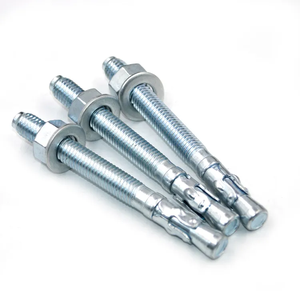
Through-fixing heavy concrete anchors for heavy machinery leveling and safety harness tie-offs. Zinc electroplated and hot-dip galvanized variants with single-piece clip geometry.
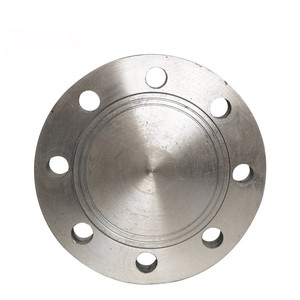
Large-diameter ring type joint (RTJ) and raised face (RF) forged blind flanges for high-pressure oil, natural gas, and LNG trunk pipelines. Normalized forging structure certified under PED 2014/68/EU.
In structural lifting and overhead rigging, an eye bolt is not a generic mechanical fastener; it is legally categorized as lifting equipment under the European Machinery Directive 2006/42/EC. Specifying lifting points requires thorough compliance with EN ISO 3266, DIN 580, and ASME B18.15 to prevent catastrophic shearing under multi-axis loads.
The primary vulnerability in commercial-grade eye bolts is structural brittleness resulting from bar-machined shank-to-collar transitions or unverified cast iron matrices. Certified lifting eye bolts demand closed-die hot drop forging from fine-grain killed carbon steel (C15E per EN 10084), alloy steel (42CrMo4 / AISI 4140 quenched and tempered to Grade 80 or Grade 100), or solution-annealed austenitic stainless steel (AISI 316 / 1.4401).
Closed-die forging forces continuous, uninterrupted metallurgical grain flow around the entire eye perimeter and downward through the integral shoulder into the shank core. This structural alignment eliminates microscopic internal shear planes, guaranteeing high impact energy absorption even under sub-zero ambient testing temperatures (-20°C to -40°C Charpy V-notch verification).
Every lifting eye bolt leaving our facility is stamped with unambiguous safety markings: Working Load Limit (WLL) in metric tons, CE conformity mark, manufacturer identification symbol, steel grade (e.g., 4.8, 8.8, G80), thread size, and a traceable heat batch identification code linked to Mill Test Certificates per EN 10204 Type 3.1.
100% individual or lot-based proof testing applying 250% of rated working load without yielding or micro-cracking, backed by non-destructive magnetic particle inspection (MPI).
Components undergo cyclical dynamic fatigue testing up to 20,000 cycles at 1.5 times WLL in conformance with EN 1677-1 lifting point standards.
Raw bar stocks undergo spectrographic chemical analysis and tensile verification before hot heading. Melt heat numbers are tracked through to final packing.
Production systems accredited under the European Pressure Equipment Directive, meeting stringent mechanical safety parameters for pressurized process infrastructure.
| Thread Metric Size | Axial Lift (0° Vertical) | Angle 45° (Single Leg) | Angle 45° (Side In-Plane) | Angle 90° (Orthogonal) | Minimum Thread Engagement | Safety Factor |
|---|---|---|---|---|---|---|
| M8 x 1.25 | 140 kg (0.14 t) | 100 kg (0.10 t) | 95 kg (0.095 t) | 70 kg (0.07 t) | 1.0 x Dia (Steel) / 2.0 x (Alum) | 4:1 (DIN 580) / 5:1 (G80) |
| M12 x 1.75 | 340 kg (0.34 t) | 240 kg (0.24 t) | 230 kg (0.23 t) | 170 kg (0.17 t) | 1.25 x Dia (Cast Iron) | 4:1 (DIN 580) / 5:1 (G80) |
| M16 x 2.00 | 700 kg (0.70 t) | 500 kg (0.50 t) | 460 kg (0.46 t) | 350 kg (0.35 t) | 1.5 x Dia (Low Carbon Steel) | 4:1 (DIN 580) / 5:1 (G80) |
| M20 x 2.50 | 1,200 kg (1.20 t) | 860 kg (0.86 t) | 830 kg (0.83 t) | 600 kg (0.60 t) | 1.5 x Thread Pitch Diameter | 4:1 (DIN 580) / 5:1 (G80) |
| M24 x 3.00 | 1,800 kg (1.80 t) | 1,290 kg (1.29 t) | 1,200 kg (1.20 t) | 900 kg (0.90 t) | 1.75 x Dia (Soft Alloys) | 4:1 (DIN 580) / 5:1 (G80) |
| M30 x 3.50 | 3,200 kg (3.20 t) | 2,300 kg (2.30 t) | 2,150 kg (2.15 t) | 1,600 kg (1.60 t) | 2.0 x Dia (Light Cast Metals) | 4:1 (DIN 580) / 5:1 (G80) |
| M36 to M100 | 4,600 kg to 40,000 kg+ | Engineering Review | Engineering Review | De-rated by 50% max | Tailored to Substrate Tensile | Individually Certified |
Established in 2010 in Mumbai, Viha Steel & Forging has grown into an internationally audited supplier of critical industrial fasteners, forged flanges, and rigging components for heavy industrial projects.
Industrial procurement failures stem predominantly from fragmented documentation and unverified material substitutions. As an active member of the Fastener Manufacturers Association of India (FMAI) and certified under PED 2014/68/EU, our operations bridge the gap between heavy forge shop power and precision laboratory scrutiny.
Our forged eye bolts, heavy hex bolts, stud bolts, and ASME B16.5 / B16.47 flanges are actively deployed across major LNG terminals, offshore platforms, high-speed rail corridors, and refining installations in Far East Asia, the Middle East Gulf region, and West Africa. We maintain end-to-end control from raw bar chemistry to final protective packing, eliminating non-conformance risks on site.
Whether you require standard DIN 580 eye bolts in high-tensile 8.8 grade, extreme-environment 316 stainless steel eye nuts, or bespoke forged lifting brackets manufactured to CAD tolerances, our engineering desk aligns commercial and technical parameters with your project schedules.
Subsurface crack detection and dye penetrant testing conducted on forged eyes and heavy structural bolts prior to threading and final surface finishing.
Beyond standard carbon and stainless grades, our forge lines produce silicon bronze, phosphor bronze, aluminum bronze, and titanium fasteners for marine applications.
In-house quality protocols ensure zero thread clogging on hot-dip galvanized (HDG) threads, offering structural atmospheric protection across 25+ years.
Seaworthy crating, vapor-corrosion-inhibitor (VCI) bagging, and digital MTC document bundles formatted for seamless customs clearance at destination ports.
Global supply chains are moving away from reactive spot purchasing toward integrated digital verification, advanced alloy design, and zero-carbon metallurgical tracking.
Next-generation CE certified eye bolts increasingly feature integrated, embedded RFID or NFC chips inside forged recesses. Field riggers and safety auditors can instantly scan the lifting eye using handheld devices to review proof load test dates, installation cycles, and remaining operational lifespan, eliminating paper logging errors during statutory LOLER inspections.
Traditional rigid DIN 580 eye bolts suffer severe load de-rating (up to 75% capacity loss) when exposed to orthogonal side-loading. Procurement demand across automated gigafactories and wind turbine assembly hubs is shifting to articulating, 360-degree rotating swivel hoist rings that automatically align with the sling tension vector, maintaining 100% WLL through all lift angles.
Under the European Union Carbon Border Adjustment Mechanism (CBAM), enterprise EPC buyers require verified Scope 1, 2, and 3 embodied carbon declarations on all forged steel and fastener exports. Forward-looking procurement programs require mills to produce verified Digital Product Passports (DPP) detailing recycled scrap content, electric arc furnace (EAF) melts, and supply chain emissions data.
Clear engineering answers to essential sizing, safety factors, certification mandates, and metallurgical constraints encountered during rigging procurement.
A CE certified eye bolt is legally regulated as lifting machinery equipment under EU Directive 2006/42/EC and EN ISO 3266. It requires hot closed-die forging, mandatory proof testing at 2.5 times the Working Load Limit (WLL), dynamic fatigue testing, minimum Charpy impact ratings at sub-zero temperatures, and complete EN 10204 3.1 chemical and mechanical traceability. Commercial-grade eye bolts often use unrated cast steel intended purely for light tie-downs, presenting high catastrophic brittle failure risks under dynamic overhead loads.
When lifting at an angle away from the vertical axis, the effective capacity drops rapidly due to bending moments exerted on the bolt shank. A shoulder pattern eye bolt (DIN 580) loaded at a 45-degree angle in-plane must be de-rated to approximately 30% of its rated axial WLL. Out-of-plane side lifting can drop the allowable load to 25% or lower. Non-shoulder eye bolts must strictly be restricted to 0-degree vertical lifts and should never be loaded at an angle.
Minimum thread engagement depends on the ultimate tensile strength of the receiving substrate. For structural steel (tensile strength > 500 MPa), the minimum thread depth should be 1.0 to 1.25 times the nominal bolt diameter. For lower tensile cast iron components, a minimum of 1.5 times the diameter is mandated. When fastening into ductile light aluminum or magnesium alloys, thread engagement must be increased to 2.0 to 2.5 times the diameter to prevent thread stripping before the bolt tensile yield is reached.
Electroplating or hot-dip galvanizing high-strength alloy steels (hardness > 320 HV or tensile strength > 1000 MPa, such as Grade 10.9 or Grade 100 lifting bolts) involves acid pickling, which introduces the danger of Hydrogen Embrittlement. For high-tensile lifting gear, zinc-flake coatings (Geomet / Dacromet) or mechanical plating without acidic immersion are required by international lifting safety standards to eliminate sub-surface hydrogen stress fracturing.
Every single manufacturing run begins with dedicated ingot heat numbers. Throughout our hot forging, machining, heat treatment, thread rolling, and finishing stages, the heat batch designation is physically stamped into the collar of each bolt or flange. Our delivered shipments are supported by comprehensive Mill Test Certificates per EN 10204 3.1, documenting actual optical emission spectrometry results, Charpy impact toughness, yield strength, and NDT proof load validation.
AISI 316 (A4-80) contains 2.0% to 3.0% molybdenum, giving it superior resistance to chloride-induced pitting and crevice corrosion compared to carbon steel or standard 304 stainless. It is required for marine splash zones, offshore petrochemical decks, coastal crane assemblies, and chemical processing facilities. When specified, cold-work hardened A4-80 eye bolts offer equivalent mechanical yield characteristics while maintaining corrosion resistance without surface coating wear.
Whether you require scheduled project supplies of DIN 580 lifting eye bolts, ASTM A193 B7 stud bolts, or ASME B16.47 heavy forged blind flanges, our engineering and export desk is standing by to deliver comprehensive technical schedules, MTC drafts, and firm FOB/CIF quotations.
Get a Quote