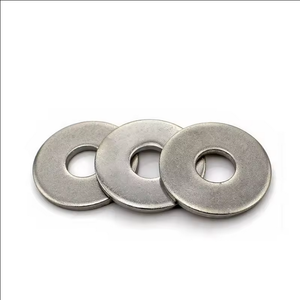
Precision-stamped, deburred, and metallurgically verified washers tailored for severe bolted joint conditions, petrochemical infrastructure, automotive assemblies, and extreme pressure machinery.
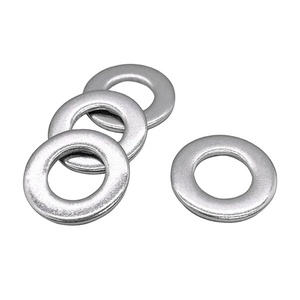
Engineered for M3–M8 metric threaded fasteners with zinc plated or mirror-plain passivated finish. Prevents surface galling under tight torque.
Quenched and tempered medium carbon steel washers providing certified compressive resistance against embedded bolt head sinkage under high preload.
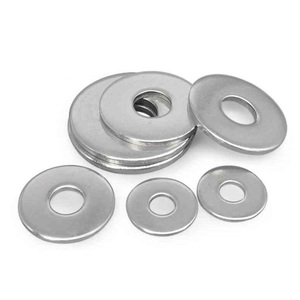
USS heavy industrial dimensioned washers spanning 3/16" to 1-1/2". Maximizes structural surface contact area across structural beam bolted flanges.
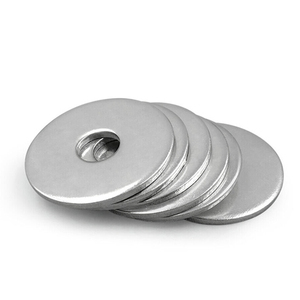
Extra-wide external diameter fender washers designed for sheet metal, timber decking, and thin-gauge composite assemblies to stop pull-through.
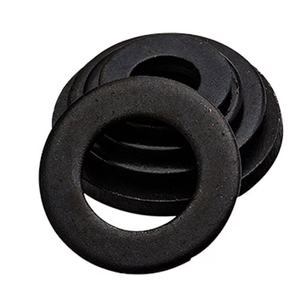
Heat-treated 8.8 grade structural washers engineered specifically for automotive powertrain mounts, heavy yellow goods, and vibrating machinery frames.
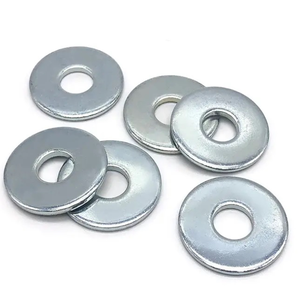
Molybdenum-alloyed austenitic stainless washers built to survive coastal spray, chemical process vessels, and off-shore subsea valve installations.
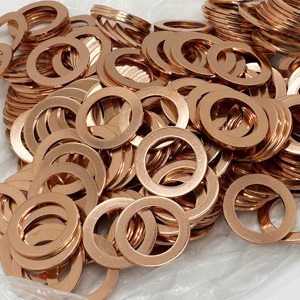
Annealed C11000 electrolytic copper and Virgin PTFE washers for diesel injector nozzles, hydraulic banjos, and thermodynamic refrigeration joints.
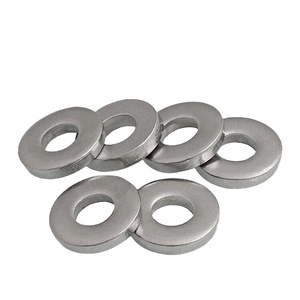
Engineered extra-thick profile designed to resist deflection under extreme bolt tightening forces in heavy railway and structural chassis bolting.
Why precise flatness, mechanical hardness, and dimensional tolerance matter far beyond simple spacing in high-load industrial joints.
Critical Mechanical Insight: In critical structural and piping connections, a flat washer is never merely a shim. Its primary mechanical objective is twofold: dissipating axial bolt clamp load across a wider bearing area (reducing localized surface stress below the yield point of the fastened substrate) and establishing a predictable, uniform friction surface (reducing scatter during torque-angle bolt tensioning).
| Material / Standard Grade | Hardness Spec (HV / HRC) | Tensile Strength (MPa) | Corrosion Resistance Class | Primary Industrial Sector |
|---|---|---|---|---|
| DIN 125A / ISO 7089 Carbon Steel | 140 HV / 200 HV min | 400 – 600 MPa | Zinc Plated / HDG | General Machinery, Construction Fasteners |
| DIN 7349 Heavy Quenched 45# / 40Cr | 200 – 300 HV (30+ HRC) | 800 – 1040 MPa | Black Oxide / Geomet | Heavy Plant Chassis, Automotive Drivetrain |
| A2-70 Stainless (AISI 304 / 1.4301) | 160 – 210 HV | 700 MPa min | High Atmospheric | Food Machinery, Architectural Envelope |
| A4-80 Stainless (AISI 316 / 1.4401) | 180 – 230 HV | 800 MPa min | Marine / Chemical | Offshore Oil & Gas, Desalination Plants |
| C11000 High-Conductivity Copper | 50 – 85 HV (Dead Soft Annealed) | 200 – 260 MPa | Oxidation Resistant | Fuel Injector Banjo, Cryogenic Crush Seals |
| Virgin Sintered PTFE (Teflon) | Shore D 55 – 65 | 20 – 35 MPa | Universal Chemical | Dielectric Isolation, Ultra-Pure Acids |
Combining world-class progressive stamping throughput with rigorous metallurgical quality control rooted in certified industrial manufacturing standards.
Manufactured under strict pressure vessel equipment directives (PED certification) and quality regimes. Every batch of stamped washers retains complete EN 10204 3.1 heat-number traceability back to the parent steel melt.
In-house progressive die design and maintenance guarantee clean shearing, zero inner-diameter (ID) burrs, flat planar surfaces, and consistent edge chamfers that eliminate stress risers under high-tensile bolt heads.
Equipped with 360-degree high-speed glass disk optical sorting machines verifying thickness, outer diameter, concavity, and concentricity to satisfy automotive AIAG PPAP Level 3 requirements with near-zero defect rates.
Offering specialized surface treatments including Cr-free Zinc Flake (Geomet/Dacromet), Hot Dip Galvanizing (HDG) per ASTM A153/ISO 10684, Zinc-Nickel alloy electroplating (>1,000 hrs NSS), and chemical passivation.
Equipped with optical emission spectrometers (OES), Vickers & Rockwell hardness indenters, salt spray chambers, and digital coordinate measuring machines (CMM) to provide unquestionable empirical test data.
Beyond standard DIN 125, DIN 9021, and DIN 7349, we rapid-prototype non-standard custom shapes, slotted washers, wave profiles, and dual-metal bonded isolation gaskets per client drawings in 7-10 working days.
How automation, carbon-neutral metallics, and electric mobility joint dynamics are reshaping the global procurement landscape.
The acceleration of EV battery pack modularization requires specialized non-conductive flat washers and dual-material laminate washers (e.g., aluminum-steel cladded or PEEK coated) that mitigate galvanic cell reactions between aluminum battery frames and stainless fasteners.
Procurement directors are rapidly shifting away from low-cost, unverified suppliers toward audited manufacturers offering bundled assembly readiness: automated tape-and-reel or kit packing, guaranteed friction coefficient (µ) windows, and pre-applied anti-seize microencapsulations.
With EU CBAM (Carbon Border Adjustment Mechanism) taking full effect, Chinese washer producers are integrating scrap-recycled EAF (Electric Arc Furnace) strip steel with verified environmental product declarations (EPD), helping multinational OEMs hit Scope 3 emissions targets.
Empirical answers resolving real-world engineering ambiguities, metallurgical standards, and export logistics.
A standard 140HV plain washer (DIN 125A) is intended for low-to-medium strength bolts up to property class 6.8. When utilizing high-tensile property class 8.8, 10.9, or ASTM A325 fasteners, the high clamping tension will cause a soft 140HV washer to dishing or yield plastic deformation. A 200HV or 300HV washer (quenched and tempered) must be specified to maintain proper joint tension without embedding.
While all are flat circular washers, their proportions differ significantly: DIN 125 has an outer diameter approximately 2x its nominal bolt diameter; DIN 9021 (Fender) features a large OD equal to 3x nominal diameter for thin plates and timber; DIN 7349 features a substantially thickened cross-section engineered specifically to withstand heavy compression forces associated with spring-type pins and high-grade bolts.
For washers heat-treated above 320 HV (or property class 10.9 equivalent), acid pickling during pre-electroplating and cathodic hydrogen absorption present acute fracture risks. We enforce non-acid mechanical descaling (shot blasting) coupled with mandatory post-plate de-embrittlement baking at 200°C–220°C for at least 8 to 14 hours within 4 hours of electroplating, or recommend non-electrolytic zinc flake coatings.
Direct contact between stainless steel washers and carbon steel plates in the presence of an electrolyte (moisture, coastal salt air) creates a galvanic couple where carbon steel acts as a sacrificial anode, accelerating localized corrosion. Where mixed joints cannot be avoided, we supply non-conductive isolators (PTFE or vulcanized fiber washers) or heavy-duty zinc-nickel coated carbon steel washers.
Every shipment is accompanied by a certified EN 10204 Type 3.1 Inspection Certificate containing actual chemical heat analysis, micro-hardness indent results, plating thickness measurements via X-ray fluorescence (XRF), salt spray test certificates, and full dimensional inspection reports.
Standard DIN/ASME washer sizes in zinc-plated carbon steel, A2, and A4 stainless are dispatched from standing inventory in 3 to 7 days. For custom stamping with new tooling dies, sample validation prototypes are completed within 10 to 14 days, followed by full container-load production in 25 to 30 days.
Connect directly with our engineering sales desk to request material test reports, dimensional CAD drawings, volume pricing tiers, or custom stamping tooling feasibility evaluations.