Factory Direct Inventory
Featured Industrial Structural Anchor Bolts
Precision-manufactured concrete fasteners, mechanical expansion anchors, through-bolts, and high-tensile fixation hardware certified to ISO 898-1, ASTM F1554, and DIN standards with mill test certification.
Direct Manufacturing Excellence
Why Global EPCs Choose Our Anchor Bolt Factory
Operating as an integrated steel forging, cold-heading, and surface treatment complex, we merge deep metallurgical science with strict dimensional tolerance control to safeguard heavy infrastructure assets worldwide.
Zero Scrap Tolerances
Every forging and cold-formed batch is melted from primary billet stock accompanied by complete chemical spectrographic analysis. We issue EN 10204 Type 3.1 Mill Test Certificates verifying tensile yield, elongation, impact toughness at -40°C, and core Vickers/Brinell hardness distributions.
ASTM A153 & ISO 10684
Our environmental hot-dip galvanizing lines generate ultra-adherent zinc-iron alloy layers yielding coating thicknesses from 45µm to over 85µm. For chemical, subsea, and offshore refinery bolting, we supply fluoropolymer PTFE (Xylan), Sherardizing, and TiCN micro-barrier composite treatments.
ISO 4042 De-embrittlement
All high-tensile property classes (Grade 8.8, 10.9, 12.9, ASTM A193 B7) are systematically baked in computer-controlled convection furnaces within two hours of electro-cleaning to prevent hydrogen-induced delayed brittle fractures under prolonged static preloads.
Engineering Whitepaper Analysis
Mechanics of Concrete Load Transfer & Failure Modes
Anchor bolts are foundational structural elements that transmit combined shear, bending, and axial tension forces from superstructure baseplates into uncracked or cracked reinforced concrete matrices.
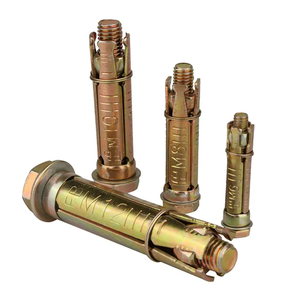
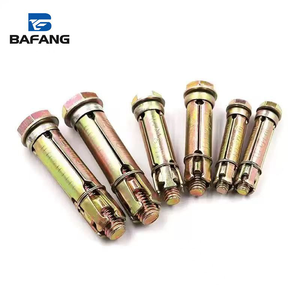
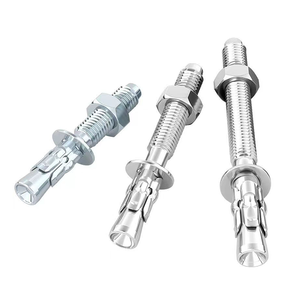
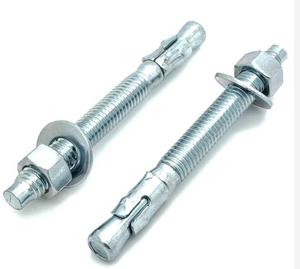
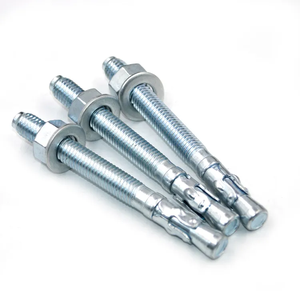
Mechanical anchors like the Wedge Anchor (Through-Bolt) and Sleeve Anchor rely on controlled mechanical displacement. As installation torque is applied to the hex nut, the precision-tapered mandrel draws upward into the cold-formed expansion clip or cylindrical slotted sleeve. This expands the steel perimeter radially outward against the bore wall of the drilled concrete aperture.
The resistance mechanism is governed by frictional friction interlocking and localized concrete compression crushing. Under cyclic seismic actions, concrete micro-cracks form and widen across the anchorage zone. Our high-performance anchor designs integrate coined dimples and embossed clips that preserve active expansion reserve margins even as crack widths reach Δw = 0.5mm under Eurocode EN 1992-4 and ACI 318-19 testing protocols.
In structural connection engineering, fastening capacity is bounded by six deterministic failure limit states defined by the Concrete Capacity Design (CCD) method:
- Steel Tensile Rupture: Occurs when applied axial tension exceeds the net cross-sectional yield or ultimate tensile strength ($N_{sa} = A_{se,N} \cdot f_{uta}$).
- Concrete Cone Breakout: The classic 35-degree failure pyramid radiating from the effective embedment depth ($h_{ef}$) out to free concrete edges.
- Pull-out & Slip Failure: Observed when expansion clips slide past the expansion cone due to undersized drill bit tolerances or aggregate polishing.
- Pry-out & Edge Shear Breakout: Driven by concentrated lateral shear loads acting close to a structural concrete edge ($c < 10 h_{ef}$).
Material Selection Guide
Anchor Bolt Metallurgy, Grades & Environmental Classes
Cross-reference material mechanical classes, yield limits, corrosion protection regimes, and standard service applications to optimize your technical bill of materials (BOM).
Strategic Sourcing Insights
Future Procurement Trends in Industrial Anchoring (2025–2030)
Navigating tectonic shifts in global construction standards, carbon border regulations, seismic resilience imperatives, and automated job site installation technologies.
National building codes across the Americas (ASCE 7), Europe (Eurocode 8), and the Asia-Pacific region are universally mandating post-installed anchor approvals under ETAG 001 / EAD 330232-00-0601 categories C1 (for non-structural elements) and C2 (for primary structural members subjected to intense cyclic shear and crack opening up to 0.8 mm). Sourcing teams are phasing out generic anchor bolts in favor of pre-qualified, code-stamped seismic anchors to insulate projects against legal and safety audit vulnerabilities.
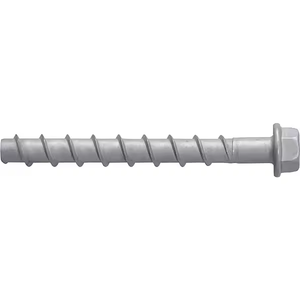
The global mechanical fastening sector is rapidly pivoting toward high-tensile, self-tapping concrete screws (such as our hexagonal flange cutting anchor series). Unlike expansion anchors, concrete screws induce virtually zero outward bursting expansion force. This allows engineers to place anchors up to 50% closer to structural edges and at substantially narrower center-to-center spacings, while reducing contractor installation man-hours by eliminating torque-wrench torque verification steps.
With the European Union Carbon Border Adjustment Mechanism (CBAM) transitioning to full financial enforcement, Tier-1 industrial buyers require certified Environmental Product Declarations (EPDs) quantifying Scope 1, 2, and 3 embedded CO2 per metric ton of steel fasteners. Our modern production lines incorporate scrap-recycled Electric Arc Furnace (EAF) wire rods, green hydrogen thermal treatment, and closed-loop acid recovery systems to deliver verifiable low-carbon anchorage solutions.
Stage 1 (Wire Rod Preparation): Prime boron alloy and carbon wire coils undergo spheroidize annealing and chemical pickling to produce an ultra-uniform pearlite microstructure suited for cold plastic deformation.
Stage 2 (High-Speed Multi-Station Forging): Cold-heading machines press the expansion dog point, collar shoulders, and head markings with continuous grain flow alignment, drastically increasing fatigue cycle limits compared to machined pins.
Stage 3 (Thread Rolling & Mesh Belt Hardening): Threads are cold-rolled between precision flat dies to class 6g / 2A dimensional tolerances without cutting fiber grains. Parts subsequently enter protective atmosphere mesh belt furnaces for controlled oil quenching and high-temperature tempering to lock in ductile, fracture-resistant hardness.
Stage 4 (Electroplating & Thermal De-Embrittlement): Automated rack and barrel plating lines apply uniform zinc deposits followed immediately by 4 to 8 hours of hydrogen bake-out at 200°C–220°C for all property classes ≥ 8.8.
Stage 5 (100% Optical Sorting): High-speed dual-camera vision inspection machines verify shank straightness, total thread length, washer thickness, and expansion collar slot geometry at 600 pieces per minute.
Stage 6 (Destructive Lab Verification): Every lot sample undergoes ultimate tensile pull-out tests on 600 kN computer-interfaced servo-hydraulic benches, combined with Charpy V-notch impact testing and continuous neutral salt spray chamber exposure (NSS 240–1000 hrs per ASTM B117).
Procurement Engineering Knowledge Base
Frequently Asked Technical & Commercial Questions
Authoritative insights addressing critical engineering tolerances, installation parameters, international compliance standards, and supply chain logistics for B2B buyers.
What is the critical difference between Wedge Anchors, Sleeve Anchors, and Drop-In Anchors?
+
Wedge Anchors (Through-Bolts) are engineered primarily for solid concrete and cracked concrete. The hole drilled in the fixture matches the anchor bolt diameter, enabling direct "through-the-fixture" installation without lifting heavy equipment off the slab. Sleeve Anchors incorporate an external tubular sleeve running the full length of the bolt body, distributing expansion stresses across a broader surface area. This makes sleeve anchors superior in softer materials such as CMU masonry, solid brick, and hollow core prestressed slabs. Drop-In Anchors are internally threaded female anchor bodies driven flush into concrete using an internal punch and displacement plug, commonly utilized for hanging threaded rods in MEP, fire sprinkler, and ductwork suspension.
How do you calculate minimum embedment depth ($h_{ef}$) and prevent concrete cone breakout?
+
Effective embedment depth ($h_{ef}$) measures the vertical distance from the concrete surface to the deepest point where the expansion clip engages the surrounding concrete matrix. Per ACI 318 Chapter 17 and EN 1992-4, the nominal concrete breakout strength in tension ($N_{cb}$) is proportional to the embedment depth raised to the power of 1.5 ($h_{ef}^{1.5}$) in uncracked concrete, and reduced by approximately 30% in cracked zones. To prevent premature concrete failure, the actual embedment depth must exceed the manufacturer’s minimum specified threshold ($h_{ef,min}$), while maintaining edge distances ($c_{min}$) and anchor-to-anchor spacing ($s_{min}$) greater than $1.5 \times h_{ef}$ to eliminate overlapping stress pyramids.
Why is installation torque ($T_{inst}$) crucial for torque-controlled mechanical expansion anchors?
+
Installation torque ($T_{inst}$) creates the initial pretension load that draws the tapered expansion cone into the expansion collar, establishing radial contact pressure with the hole wall. If undertorqued, the anchor cannot generate sufficient frictional bite, resulting in uncontrolled slip and premature pullout when service loads are applied. Conversely, if overtorqued with an uncalibrated impact driver, the concrete localized around the cone will crush or crack, or the bolt shank will experience combined torsional shear and axial yielding, permanently diminishing its ultimate pullout capacity. We provide calibrated installation torque charts for every bolt size and grade.
How does your factory protect Grade 8.8 and 10.9 anchor bolts against Hydrogen Embrittlement?
+
High-tensile fasteners (core hardness exceeding 31 HRC / 300 HV) are highly susceptible to Hydrogen Embrittlement (HE) when atomic hydrogen liberated during chemical pickling or electroplating diffuses into the stressed crystal lattice dislocations. In our factory, all high-tensile components are cleaned using non-acid mechanical shot-blasting whenever feasible. Where electro-galvanizing is required, anchors are loaded into calibrated de-embrittlement ovens within a strict 2-hour window post-plating, undergoing thermal relief baking at 200°C to 220°C for a minimum of 4 to 8 hours depending on diameter. We verify batch compliance via sustained load pre-stress testing according to ISO 4042 and ASTM F1941.
What documentation accompanies export shipments to ensure structural compliance?
+
Every export container dispatched from our facility includes an exhaustive QA/QC Documentation Dossier: (1) Official EN 10204 Type 3.1 Inspection Certificate traceable directly to the raw material heat number; (2) Chemical Spectrographic Analysis detailing C, Si, Mn, P, S, Cr, Mo, and B concentrations; (3) Mechanical Test Reports documenting Ultimate Tensile Strength ($R_m$), Yield Strength ($R_{eH}$), Elongation ($A$), and Charpy V-Notch Impact Energy (Joules); (4) Zinc Coating Thickness Measurement and Neutral Salt Spray Test (NSS) logs; and (5) Dimensional Verification Reports validated with computerized optical profilometers. Third-party inspections via SGS, BV, or TÜV are welcomed and regularly conducted on site.
Can you manufacture custom anchor bolts per engineering drawings and OEM specifications?
+
Yes. In addition to standard DIN, ISO, and ANSI/ASME wedge and sleeve anchors, our custom fabrication tooling allows for rapid prototyping and mass-scale production of specialized heavy foundation anchors. This includes ASTM F1554 Grade 36, 55, and 105 J-Bolts, L-Bolts, Double-End Plate Welded Anchor Rods, Swaged Foundation Bolts, and custom sleeve assemblies up to M100 thread diameters and lengths up to 6,000mm. We accommodate custom head stampings, proprietary customer logo markings, and tailored thread pitches (Metric, UNC, UNF, 8-UN).