
From high-machinability non-ferrous fasteners to critical pipeline flanges and structural expansion anchoring assemblies, our integrated facilities deliver turnkey solutions with full chemical, mechanical, and dimensional traceability.
Modern electrical, automotive, marine, and HVAC infrastructures demand fastening components engineered with tight dimensional tolerances, non-magnetic signatures, superior electrical conductivity, and high resistance to biofouling and galvanic corrosion. Our custom manufacturing facility optimizes brass metallurgical properties to eliminate stress corrosion cracking (SCC) while maximizing production throughput.
Recognized globally as the reference standard for high-speed automatic screw machine operations. Formulated with carefully dispersed microscopic lead globules, it yields crisp chip breakability, outstanding dimensional stability under heavy tool feeds, and minimum burr formation.
Engineered explicitly for pressurized potable water, HVAC manifolds, and geothermal installations. Through precise micro-alloying with Arsenic (As) and tight control of alpha-beta phase ratios, our DZR fasteners prevent the leaching of zinc in hot, chlorinated, or slightly acidic water.
Incorporating tin into copper-zinc crystal matrix (C46400 naval brass), or utilizing silicon bronze (C65500), aluminum bronze (C95400), and phosphor bronze (C51000). Built for offshore subsea skids, shipboard electrical housings, and coastal infrastructure subjected to relentless saline sprays.
Cross-reference material grades against critical mechanical properties to ensure structural integrity across your engineering assemblies.
| Alloy Designation | Standard Reference | Tensile Strength (MPa) | Yield Strength 0.2% (MPa) | Elongation (%) | Electrical Conduct. (% IACS) | Key Engineering Applications |
|---|---|---|---|---|---|---|
| C36000 / CW614N | ASTM B16 / EN 12164 | 380 – 540 | 230 – 380 | 12 – 25 | 28% | Precision CNC threaded inserts, terminal pins, standoffs |
| CW602N (DZR) | EN 12165 / AS 2345 | 360 – 460 | 180 – 280 | 18 – 30 | 26% | Hydraulic valve stems, HVAC pipe couplings, flow meters |
| C46400 (Naval Brass) | ASTM B21 / QQ-B-637 | 420 – 590 | 210 – 360 | 15 – 35 | 26% | Marine hardware, seawater condenser bolting, shaft sleeves |
| C65500 (Silicon Bronze) | ASTM B98 / AMS 4616 | 515 – 680 | 280 – 420 | 15 – 25 | 7% | Subsea anchoring, switchgear bolting, chemical vat vats |
| C51000 (Phosphor Bronze) | ASTM B139 / DIN 17662 | 450 – 620 | 250 – 400 | 12 – 28 | 15% | Fatigue-resistant electrical contacts, leaf springs, clips |
| CW724R (Ecobrass) | DIN EN 12164 (Lead-Free) | 580 – 760 | 350 – 520 | 10 – 18 | 8% | Automotive EV battery packs, medical fluidics, drinking water |
B2B procurement leaders are transforming how non-ferrous and precision fasteners are sourced, moving from transactional spot purchases to risk-hedged strategic supply chain partnerships.
With stringent revisions to the European Drinking Water Directive, EU RoHS Exemption 6(c) phase-down, and US Safe Drinking Water Act (SDWA), industrial buyers are migrating to silicon-doped copper alloys (CW724R / CuZn21Si3P) to achieve sub-0.1% lead ceilings without compromising stress corrosion resistance.
Geopolitical tariffs and oceanic freight volatility have catalyzed Vendor Managed Inventory (VMI) frameworks. Buyers demand manufacturers capable of maintaining buffer stocks with consignment warehousing, paired with dual-sourcing production lines spanning India and East Asian industrial corridors.
Manual batch sampling is obsolete in automated electronic assembly and EV power electronics. Tier-1 assemblers require 100% automated high-speed 360-degree vision sorting, guaranteeing thread integrity, unblocked internal hex drives, and underhead radii within 10–30 PPM error rates.
Because virgin copper extraction requires high energy, leading procurement directors require raw material billets sourced from certified secondary remelting foundries with documented low carbon footprints (Scope 3 emissions) and strict batch scrap buyback protocols.
Founded in 2010 in Mumbai, our organization has evolved from a premier steel forging and industrial bolting manufacturer into a globally trusted OEM/ODM engineering titan. As a recognized member of the Fastener Manufacturers Association of India (FMAI) and a certified PED (Pressure Equipment Directive) approved production facility, we unite heavy metallurgical discipline with microscopic CNC machining accuracy.
Our comprehensive production footprint houses high-speed Swiss-type multi-axis CNC turn-mill centers, multistation cold headers, automated induction hot forging presses, and continuous quench-and-temper heat treatment belts. Whether producing micro-diameter M1.2 brass inserts for telecommunications or massive M100 high-tensile alloy studs for subsea LNG terminals, every lot is accompanied by a certified EN 10204 3.1 Mill Test Certificate (MTC) verifying spectroscopic chemical compositions and physical pull-test parameters.
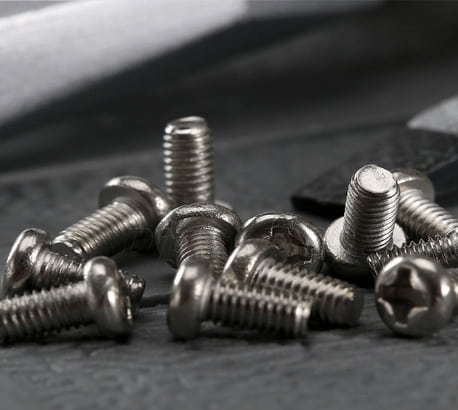
Explore the process innovations driving scrap elimination, cycle time reduction, and microscopic surface finish optimization across our customized brass fastening lines.
Traditional brass machining generates up to 45% scrap swarf. We integrate high-speed multistation cold heading for net-shape preforms, followed by secondary precision CNC threading and diamond-tool facing. This preserves uninterrupted grain flow, elevating ultimate shear strength by up to 22% while drastically cutting cycle times.
To combat galvanic action when brass contacts aluminum structural extrusions, our surface treatment line provides automated Electroless Nickel (ENP), Tin-Zinc diffusion barriers, and Physical Vapor Deposition (PVD). These treatments impart neutral salt-spray endurance beyond 1,000 hours without thread dimension clogging.
Every critical batch destined for high-reliability automotive sensors or electrical switchgear is passed through 3-camera telecentric optical rotary sorters. Pitch diameter, lead angle deviation, plating thickness variations, and head concentricity are dynamically evaluated at up to 1,200 parts per minute.
Concrete answers to the real metallurgical, financial, and logistical questions raised by global supply managers and design engineers.
Prototype samples and First Article Inspection (FAI) reports with complete CMM dimensional scans are typically dispatched within 7 to 10 working days from 2D/3D drawing sign-off. High-volume mass production runs generally require 3 to 4 weeks depending on the complexity of secondary operations such as broaching, cross-hole drilling, or specialty chemical passivation.
When brass is coupled with less noble metals like carbon steel or structural aluminum in the presence of an electrolyte, galvanic acceleration occurs. We engineer isolation solutions including engineered EPDM/PTFE non-conductive washers, or apply selective electrodeposited sacrificial coatings such as Zinc-Nickel (Zn-Ni) or pure Tin (Sn) plating to harmonize electrochemical potential differentials.
Yes. For automotive, aerospace, and critical power generation clients, we provide complete Production Part Approval Process (PPAP) Level 3 packages. This includes Design Records, Process Flow Diagrams, Process FMEA, Control Plans, Measurement System Analysis (Gage R&R), Dimensional Results, Material & Performance Test Results, and the Part Submission Warrant (PSW).
Our CNC turning and thread rolling lines routinely sustain 6g and 4h tolerances for external threads and 6H / 4H for internal tapped threads in metric standards, as well as Class 2A / 3A and 2B / 3B per ASME B1.1 for imperial unified threads. All threads are 100% verified using calibrated hard-chrome GO / NO-GO ring and plug gages, monitored by statistical process control (SPC).
Our MOQ is engineered to support both scaling startups and global multinational contracts. For custom screw machine parts manufactured via multi-spindle automatics or CNC lathes, standard runs start at 5,000 to 10,000 units. For cold-headed brass hardware, minimum economic run quantities generally begin at 25,000 units, with pilot tooling runs accommodated on demand.
Every commercial consignment includes an EN 10204 Type 3.1 inspection certificate traceable directly to the raw material melt heat number. Testing covers Optical Emission Spectrometry (OES) chemical analysis, Rockwell/Vickers hardness checks, tensile testing, salt spray corrosion tests (ASTM B117), and full dimensional reports from our optical comparators and Zeiss CMMs.
Submit your 2D engineering drawings (PDF / DWG) or 3D CAD models (STEP / IGES) today. Our metallurgical and application engineers provide DFM feedback, tolerance optimization, and transparent tiered factory-direct volume pricing within 24 hours.
Get Catalog