
Precision-engineered DIN 603, ANSI B18.5, and ISO standard carriage bolts manufactured under strict ISO 9001:2015 and IATF 16949 quality controls.

As global industrial supply chains demand higher mechanical reliability and rigorous cost transparency, China remains the undisputed global center for cold-forged steel fasteners, producing over 55% of the world's standard and bespoke structural bolts. The Chinese carriage bolt manufacturing ecosystem—centered in heavy industrial hubs across Zhejiang (Ningbo, Haiyan) and Hebei (Handan)—combines fully integrated raw wire rod mills, multi-station automatic cold headers, and automated continuous heat treatment lines.
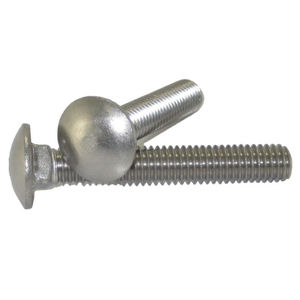
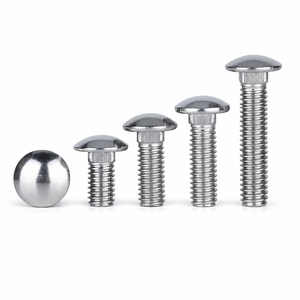
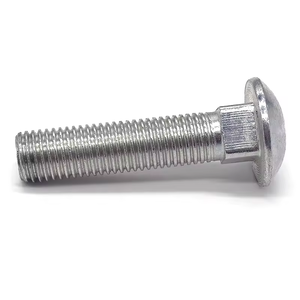
A carriage bolt (historically known as a coach bolt or round-head square-neck bolt) features a specialized mechanical profile. The smooth, domed mushroom head eliminates the requirement for an exposed driving recess (such as a hex socket or phillips drive), serving as a crucial anti-tamper security feature. Directly below the shallow cup head, an integrated square shank embeds itself into timber, composite substrates, or pre-punched steel channels. This square neck locks the fastener firmly in place, allowing single-sided installation using a single wrench on the mating hexagon nut without risking shank spin or torque slippage.
Direct supply agreements with Tier-1 steel mills (SWA, Baosteel) guarantee batch-to-batch chemical homogeneity in SWRCH10K, 35K, 45K, and AISI 304/316 rod stock.
High-speed 5-station and 6-station matrix cold headers form head profiles and square necks with zero micro-fracturing along grain boundaries.
Thread profiles are formed post-heat treatment via hydraulic planetary roll dies, maintaining tight 6g/6H pitch tolerances with superior fatigue life.
Overseas procurement executives, structural engineers, and industrial distributors sourcing from top-tier Chinese carriage bolt exporters gain significant economic and technical advantages. By leveraging automated optical sorting machines (which eliminate dimensional flaws down to < 50 PPM) alongside sophisticated electrolytic and hot-dip surface finishing, leading Chinese exporters deliver structural integrity matching European and North American standards at optimized unit costs.
Specifying the exact carriage bolt standard is paramount to ensuring joint integrity under mechanical shear, vibration, and environmental stress. Industry standards dictate distinct head heights, square neck depths, thread pitch profiles, and radius under-head fillets. The table below details the technical cross-references used across international engineering projects:
| Standard Ref. | Head Style / Description | Available Diameters | Mechanical Property Classes | Primary Industrial Sector |
|---|---|---|---|---|
| DIN 603 | Round Head Square Neck Bolt | M5 to M24 | Class 4.8, 6.8, 8.8, 10.9 / Stainless A2-70, A4-80 | Timber framing, solar racking, modular building |
| ANSI/ASME B18.5 | Imperial Round Head Square Neck | #10 (0.190") to 3/4" | SAE J429 Grade 2, Grade 5, Grade 8 | Agricultural machinery, heavy trucking, bridges |
| ISO 8677 | Metric Cup Head Square Neck | M5 to M20 | Property Class 4.8, 8.8 / Austenitic Stainless Steel | Highway guardrails, playground equipment |
| DIN 608 | Countersunk Square Neck Bolt | M10 to M16 | Property Class 8.8, 10.9 Alloy Steel | Agricultural plows, earthmoving equipment wear-plates |
| Custom Micro | Precision T-Bolt / Micro Square Neck | M0.8 to M2.5 | Carbon Steel (Zinc/Black Oxide), Stainless 304 | Consumer electronics, robotics, micro-assemblies |
Choosing the correct alloy composition prevents unexpected yield failure or stress corrosion cracking (SCC):
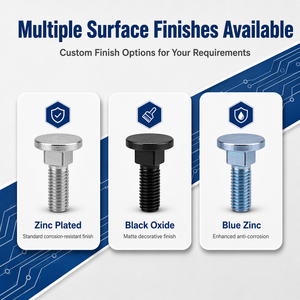
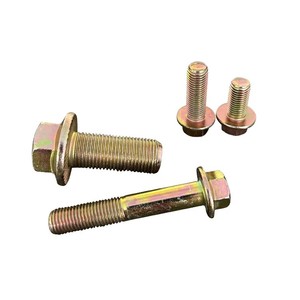
Fastener longevity is heavily dependent on surface barrier treatments. In coastal or industrial atmospheres, unprotected carbon steel carriage bolts suffer rapid oxidation. Leading Chinese manufacturing plants utilize computerized plating and coating lines to achieve targeted Salt Spray Test (NSS per ISO 9227 / ASTM B117) ratings:
Film Thickness: 5 µm - 12 µm
NSS Resistance: 72h to 240h to red rust
Best For: Dry indoor environments, furniture, and light enclosure assembly requiring bright silver or yellow aesthetics.
Film Thickness: 45 µm - 85 µm
NSS Resistance: 1,000h+ to red rust
Best For: Heavy outdoor civil engineering, highway guardrails, timber bridges, and utility pole hardware.
Film Thickness: 6 µm - 15 µm
NSS Resistance: 1,000h to 1,500h
Best For: Zero hydrogen embrittlement risk; ideal for Class 10.9 high-tensile bolts used in automotive underbodies and solar trackers.
The global industrial fastener market is undergoing a structural shift driven by automation, environmental compliance, and supply chain digitization. B2B procurement professionals must align their sourcing strategies with key upcoming industry developments:
A. ESG and Green Steel Manufacturing: International buyers are increasingly evaluating suppliers based on Carbon Border Adjustment Mechanism (CBAM) compliance and Scope 1 & 2 carbon footprints. Leading Chinese carriage bolt factories are rapidly transitioning to electric arc furnace (EAF) steel wire rods, powered by local solar arrays, reducing lifecycle carbon emissions by up to 35%.
B. AI-Powered Optical Sorting and Smart QC: Quality control is moving away from manual batch sampling to 100% inline automated glass plate optical sorting. Advanced multi-camera vision systems measure head symmetry, square neck sharp corners, pitch diameter, and thread lead accuracy at speeds up to 1,200 pieces per minute, driving defect rates down toward zero PPM.
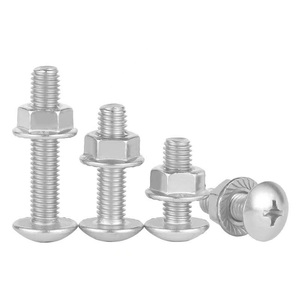
C. Growth in Solar Racking and Offsite Construction: The rapid rollout of utility-scale ground-mounted PV solar arrays and modular prefabricated housing is creating record demand for specialized DIN 603 and custom large-head carriage bolts fitted with pre-assembled serrated flange nuts. These integrated fastener kits streamline field installation speeds by more than 40%.
To eliminate procurement risks, technical purchasing teams should mandate full material and dimensional traceability before issuing POs to overseas manufacturers. Ensure your manufacturing partner provides the following documentation:
DIN 603 is a metric standard widely used across Europe, Asia, and South America, specifying metric thread pitches (e.g., M6, M8, M10) and head dimensions in millimeters. ANSI B18.5 defines imperial dimensions (Unified National Coarse - UNC threads) in inches. While visually similar, their head diameters, square neck heights, and thread angles (60° metric vs. imperial UNC pitch) are non-interchangeable.
Spinning occurs when the square neck fails to engage firmly into the mating substrate or when the pre-drilled hole diameter is oversized. In wood applications, the square neck must bite directly into the timber walls. In metal assembly, the top plate must feature a matching square punched hole (not a round drilled hole) sized precisely to the square neck width (dimension V per DIN 603).
Standard stocked metric items (such as DIN 603 Class 4.8 Zinc or Stainless A2) typically feature low MOQs starting from 10,000 pieces per size. Custom sizes, non-standard lengths, special micro-T-bolts, or custom alloy runs (e.g., Class 10.9 HDG or A4-80) generally require minimum production batches of 50,000 to 100,000 pieces, with production lead times ranging from 20 to 35 calendar days.
High-tensile steel fasteners (hardness > 320 HV / 32 HRC) electroplated in acid baths absorb atomic hydrogen, leading to sudden delayed brittle fracture under load. To prevent this, our production protocol mandates baking the bolts in de-embrittlement ovens at 200°C–230°C within 4 hours post-plating for a minimum of 8 to 24 hours. Alternatively, non-electrolytic zinc flake coatings (such as Geomet or Dacromet) are recommended.
Yes, provided the proper property class is specified. While standard Class 4.8 carriage bolts are limited to light timber construction, Property Class 8.8 and 10.9 alloy steel carriage bolts engineered to ISO 8677 or DIN 603 specifications deliver elevated yield and shear capacity suitable for heavy structural framing, guardrail barriers, and industrial machinery enclosures.
As a leading Chinese industrial fastener manufacturer and exporter, our facility bridges high-volume cold-heading efficiency with uncompromising European quality assurance standards:
Operating over 80 automated multi-station cold-forming headers capable of producing custom micro-carriage bolts (M0.8) up to heavy industrial diameters (M36) with shank lengths extending to 300mm.
Our ISO/IEC 17025 accredited laboratory is equipped with universal tensile testing machines, Rockwell/Vickers hardness testers, optical spectrum analyzers, coating thickness gauges, and salt spray chambers.
Offering customized packing options—from bulk 25kg carton packaging on wooden pallets to retail skin-card packaging, automated box labeling, barcoding, and consolidated container shipping out of Ningbo or Shanghai ports.
Partner with China’s premier carriage bolt manufacturing specialist. Contact our engineering sales group today for instant factory-direct pricing, custom CAD drawings, and free sample requests.
Send an Inquiry