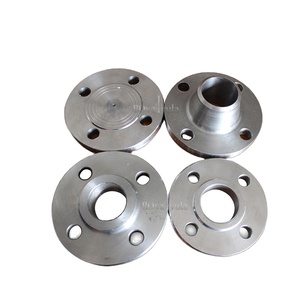
Engineered to terminate pipeline flow with zero fugitive emissions. Fully compliant with ASME B16.5, B16.47 Series A/B, DIN, and ISO specifications under rigorous QA verification.
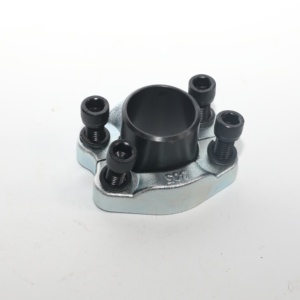
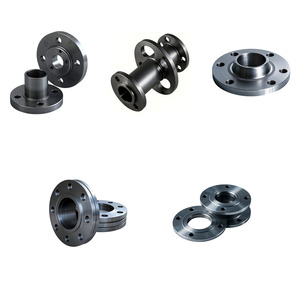
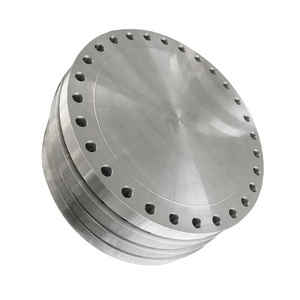
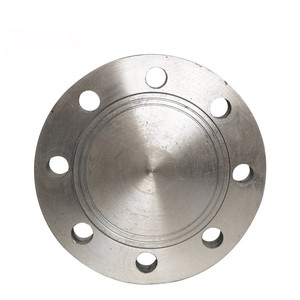
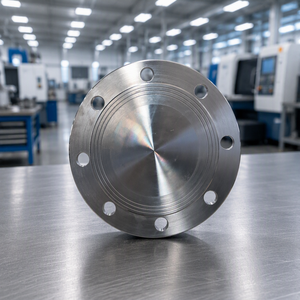
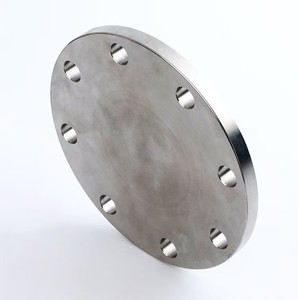
A blind flange (blanking flange) serves as the primary pressure boundary at terminal line sections. Unlike floating or neck flanges, the entire cross-sectional plate must counteract maximum bending moments and hydrostatic head pressures.
Plate-cut flanges are inherently susceptible to directional lamellar tearing under cyclic thermal swings. Our forging process enforces multi-directional radial grain alignment, delivering impact toughness exceeding 42 Joules at -46°C for ASTM A350 LF2 low-temperature variants.
Seal leakages directly stem from improper surface microfinishes. We machine standard Raised Face (RF) flanges with concentric or spiral serrations between 125–250 µin Ra (3.2–6.3 µm Ra), creating ideal bite depth for spiral-wound graphitic gaskets per ASME B16.5 Section 6.4.5.
Every blind flange is calculated using Lamé parameters and ASME Section VIII Div 1 Appendix 2 formulas. Centerline bending deflection is constrained within 0.002" per linear foot to eliminate center bowing, gasket unseating, and flange rotation issues in severe service.
| Material Grade | Yield Strength (Min) | Tensile Strength (Min) | Operating Temp Range | Matching Bolting Spec |
|---|---|---|---|---|
| ASTM A105 / A105N | 250 MPa (36 ksi) | 485 MPa (70 ksi) | -29°C to 425°C | ASTM A193 B7 / A194 2H |
| ASTM A350 LF2 Class 1 | 250 MPa (36 ksi) | 485 - 655 MPa | -46°C to 345°C (Charpy V-Notch) | ASTM A320 L7 / A194 Gr. 7 |
| ASTM A182 F316 / F316L | 205 MPa (30 ksi) | 515 MPa (75 ksi) | -196°C to 550°C | ASTM A193 B8M / A194 Gr. 8M |
| ASTM A182 F51 (Duplex 2205) | 450 MPa (65 ksi) | 655 MPa (95 ksi) | -50°C to 280°C (Chloride pitting resistant) | ASTM A193 B8M Class 2 / UNS S31803 |
Combining heavy-tonnage hydraulic forging capability with computerized heat-treatment controls, we deliver turn-key blind flange closures certified to global engineering directives.
Fully compliant with the European Pressure Equipment Directive (PED) Annex I, E.U. materials conformity, and proud membership with the Fastener Manufacturers Association of India (FMAI).
Every critical high-pressure blind flange undergoes ultrasonic examination (UT per ASME Sec V Article 4), magnetic particle testing (MPI), and liquid penetrant inspection (LPI) to eliminate void risks.
Mill Test Certificates accompany 100% of shipments. Our material documentation establishes traceable continuity linking every flange stamping directly to ladle chemical analysis and elongation logs.
We solve job-site assembly mismatches by pairing custom blind flanges with matched ASTM A193 B7/B8/B8M studs, A194 heavy hex nuts, and hot-dip galvanized coating in single-source crates.
Industrial supply chains are transitioning from reactive spot purchases to lifecycle-cost assessments, environmental resilience standards, and automated traceability.
As global LNG transport and clean hydrogen pipelines scale, standard carbon blind flanges are being replaced by micro-alloyed A350 LF2 and stabilized SS316Ti/F53 alloys. Buyers increasingly require Charpy V-notch impact validation at -196°C to prevent catastrophic cleavage fracture caused by hydrogen diffusion into steel crystalline lattices.
Counterfeit pipeline components remain an industry vulnerability. Procurement departments now require QR-coded mechanical test reports tied to distributed metallurgical databases. Our plant integrates direct laser-etched 2D Data Matrix codes tracking heat number, tensile load limits, and inspector digital signatures.
In high H2S sour gas extraction (NACE MR0175/ISO 15156), solid nickel alloy blinds are cost-prohibitive. The market is shifting rapidly to Inconel 625 / Hastelloy C-276 hot-wire TIG weld cladding over carbon steel substrates, achieving 3mm thick corrosion barriers while slashing raw material expenditures by 45%.
European and US multinational operators are demanding documented Carbon Footprint Reports (CFR). Our forging shop utilizes Electric Arc Furnace (EAF) sourced billets manufactured with up to 80% recycled ferrous scrap, reducing embedded cradle-to-gate carbon metrics compared to traditional blast furnace routes.
Traditional blind flanges are increasingly replaced during engineering phases by instrumented or tapped blinds (NPT/SW ports). This allows pipeline commissioning engineers to run hydrostatic tests, purge pipelines, and mount pressure transducers directly through the blind flange without modifying headers.
In offshore splash zones, conventional black oxide and varnish primers are obsolete. Modern project specifications dictate fluoropolymer (PTFE / Xylan) coatings, high-build epoxy, or hot-dip galvanizing to deliver salt-fog resistance exceeding 3,000 hours per ASTM B117 standards.
Essential technical clarifications addressing dimensional criteria, hydrostatic testing thresholds, and export compliance.
Yes. Per ASME B16.5 Section 6.10, blind flanges may be ordered with threaded or socket-welded tapping connections located at the geometric center or off-center, provided the tap size does not exceed nominal limits (e.g., 2" tap max for 4" to 8" flanges) and preserves the required minimum center thickness.
A slip-on flange distributes fluid stress along the connected pipe wall, which acts as a reinforced structural cylinder. A blind flange acts as an unsupported circular flat plate subjected to uniform internal hydrostatic pressure, requiring substantial cross-sectional plate thickness to prevent stress-induced plastic bending deformation.
ASME B16.47 covers large diameter flanges (26" to 60"). Series A (derived from MSS SP-44) features heavier bolt circles, larger diameter bolts, and higher material mass, making it superior for heavy piping loads. Series B (derived from API 605) utilizes smaller, compact bolt patterns optimized for compact plant designs and cost reduction.
Our Quality Management System executes 100% Volumetric Ultrasonic Examination (UT) on all forged blanks per ASTM A388 standards. Rejection criteria align strictly with API 6A and ASME Section VIII rules, guaranteeing zero internal laminations, forging bursts, or secondary piping cavity defects.
RTJ flange gasket grooves are machined to a high-precision surface smoothness not exceeding 63 µin Ra (1.6 µm Ra). The metallic octagonal or oval ring gasket deforms plastically within this groove under bolt pre-tensioning; any rough machining ridge would cause an immediate high-pressure gas bypass leak.
Yes. All blind flanges are treated with vapor corrosion inhibiting (VCI) oil, capped with industrial poly flange face protectors, vacuum sealed, and palletized in ISPM-15 heat-treated fumigated wooden boxes engineered to endure overseas container humidity, handling stresses, and long-term dock staging.
Submit your piping schedules, drawing configurations, project MTOs, and specific alloy grades to our engineering sales group. Get rapid quotes with verified MTC traceability within 24 hours.
Contact Us