Manufactured in full compliance with international standards including DIN, ASME, and ISO. Supplied with comprehensive Mill Test Certificates (EN 10204 3.1) and rigorous third-party inspection traceability.
Viha Steel & Forging operates as an internationally accredited, PED-approved manufacturing facility and an active member of the Fastener Manufacturers Association of India (FMAI).
Founded in Mumbai in 2010 as a specialized precision forging enterprise, Viha Steel & Forging has matured into a premier global manufacturer and exporter of heavy-duty industrial fasteners, bolting systems, and locking washers. Engineering installations operating across petrochemical processing, marine defense, LNG regasification terminals, and commercial power plants operate under severe harmonic vibration, high transient pressure cycling, and corrosive aggressive environments. Standard non-locking washers inevitably fail under cyclic dynamic stress due to bolt preload relaxation.
To counteract bolting failure modes, our Mumbai facility leverages vertically integrated metallurgical processes—spanning certified raw bar induction heating, closed-die precision stamping, controlled-atmosphere heat treatment (austempering and case-hardening), specialized chemical coatings (such as PTFE Xylan fluoropolymer and Hot-Dip Galvanizing), and automated optical sorting. We engineer solutions compliant with strict metallurgical limits including ASTM A193, ASTM A194, DIN 127, DIN 128, and DIN 25201.
Certified under the European Pressure Equipment Directive (PED 2014/68/EU), ensuring compliance with international pressure piping and vessel requirements.
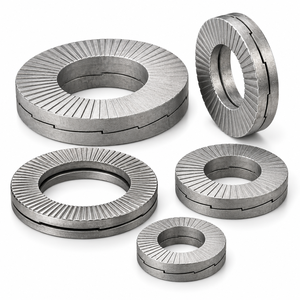
DIN 25201 wedge-locking pairs designed to harness bolt tension rather than friction, passing the rigorous Junker dynamic vibration testing standard (DIN 65151).
Manufactured from Austenitic stainless steel (304, 316, 316L, 310S), Inconel, Super Duplex 2507, Phosphor Bronze, Silicon Bronze, and Titanium alloys.
Fluoropolymer (PTFE / Xylan 1070 / 1424), Zinc Flake (Geomet / Dacromet), Hot-Dip Galvanizing (ASTM A153), and Passivated finishes for high-saline exposure.
An engineering assessment of prevailing locking mechanisms, dynamic fatigue thresholds, and international procurement trends shaping the market through 2030.
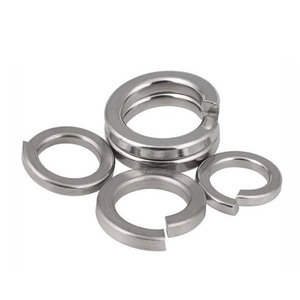
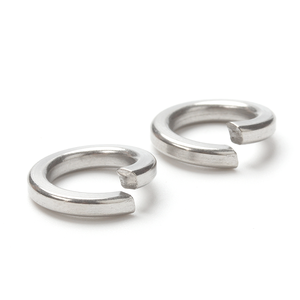
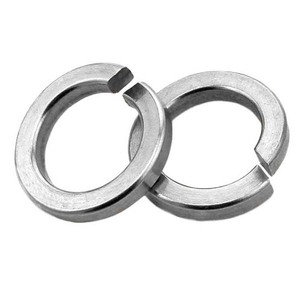
Historically, the industrial sector relied heavily on split helical spring washers (DIN 127B / ASME B18.21.1) to impart constant tension and absorb thermal displacement. While standard split rings provide adequate spring deflection for non-critical assembly, modern vibration diagnostics—such as the DIN 65151 Junker Test—demonstrate that transverse dynamic motion rapidly overcomes friction-based locks.
Consequently, procurement engineers in offshore wind turbine towers, rail transit bogies, and vibrating screening equipment are moving directly toward DIN 25201 Dual-Wedge Tension Washers. These mechanical pairs exploit ramp cams with an angle (α) greater than the thread pitch (β) of the bolt. As dynamic oscillation attempts to rotate the bolt loose, the interlocking cams generate an immediate wedge effect, transforming rotary shear into axial tension and locking the preload without reliance on frictional resistance.
Selecting the optimal lock washer involves balancing yield strength, environmental corrosion index (PREN), and galvanic isolation. The table below represents baseline performance characteristics verified by our QA testing laboratory:
| Washer Classification | Material Specification | Hardness Range (HRC / HV) | Anti-Loosening Principle | Target Industry / Primary Use |
|---|---|---|---|---|
| DIN 25201 Wedge Lock | AISI 316L / Case-Hardened Steel | 44–50 HRC / >465 HV | Geometric Cam Wedge (Tension-based) | Railways, Mining, Wind Energy, Turbomachinery |
| DIN 127B Helical Split | A2-70 (304) / Carbon Spring Steel | 40–48 HRC | Frictional Spring Deflection & Edge Bite | General Machinery, Automotive Frames, Structural Enclosures |
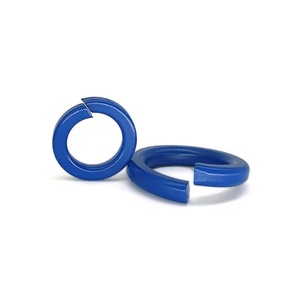
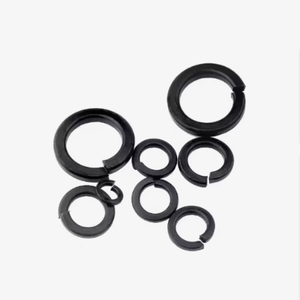
| PTFE/Xylan Split Lock | AISI 4140 / High-Tensile Alloy | 38–46 HRC | Chemical Barrier + Elastic Resistance | Subsea Manifolds, Splash Zones, Petrochem Flanges |
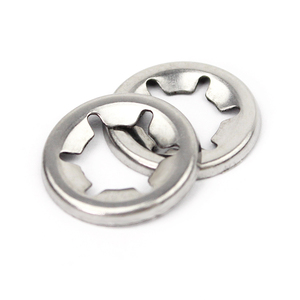
| DIN 6798 Star Tooth | Spring Steel / Stainless 301 / 304 | 350–425 HV | Multi-Point Contact & Electrical Grounding | Electronics, Switchgears, Industrial Enclosures |
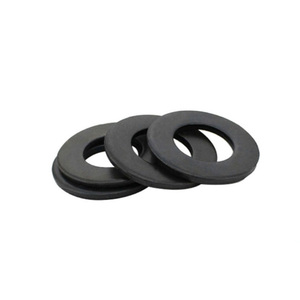
| Specialty Poly/Rubber | EPDM, Neoprene, Nylon 66 | 70–90 Shore A | Damping & Fluid Hermetic Sealing | Pneumatic Valves, Acoustic Isolation, Architectural Glazing |
A. The Rise of Zinc-Flake and Fluoropolymer Duplex Systems: Conventional electroplating poses significant risk of Hydrogen Embrittlement in high-hardness (>320 HV) spring washers. Global EPC contracts specify thin-film, non-electrolytically applied zinc flake coatings (DIN EN ISO 10683) and multi-layered fluoropolymer coatings (PTFE Xylan 1070) that survive upwards of 2,000 to 3,500 hours in neutral salt spray testing (ASTM B117) without micro-cracking.
B. Real-Time Traceability & Digital Materials Passports: Supply chain compliance under ESG frameworks requires steel bar origin verification, carbon intensity auditing, and batch-level chemical analysis. Viha Steel & Forging ensures full documentation from melt source to heat-treated batch with complete digital Mill Test Reports available for every shipment.
C. High-Strength Superalloys in Clean Energy Infrastructure: As green hydrogen electrolysis, geothermal drilling, and offshore mega-turbines expand, demand for Duplex UNS S32205, Super Duplex UNS S32750, and Inconel 718 washers is accelerating. These materials combat stress corrosion cracking (SCC) while retaining structural clamp loads across thermal gradients ranging from -196°C up to +550°C.
Detailed technical clarification on lock washer sizing, installation torque corrections, coating limits, and international delivery frameworks.
Split spring washers rely strictly on frictional forces generated by spring deflection and steel biting edges. Under significant transverse shear vibration, the spring washer can flatten or act as a low-friction slip plane, leading to bolt back-off. DIN 25201 pairs utilize mechanical cams that create a wedge lock: because the cam angle is greater than the bolt thread pitch, any rotational movement increases preload rather than loosening the joint.
Protective coatings alter the nut-friction and washer-friction coefficients. Plain steel typically has a k-factor between 0.18 and 0.22, whereas PTFE/Xylan or micro-layer zinc flake with integrated lubricants achieves a standardized friction coefficient of 0.10 to 0.15. Tightening torques must be adjusted according to technical datasheets to ensure correct bolt elongation and avoid exceeding yield strengths.
Hydrogen embrittlement occurs primarily during acid pickling and electroplating of high-strength spring steels (hardness >31 HRC). Viha Steel & Forging eliminates this risk through mechanical descaling methods, controlled-atmosphere heat treatments, mandatory post-treatment baking (de-embrittlement at 200°C–230°C per ISO 4042), and non-electrolytic zinc flake dip-spin coatings.
Single-use split helical washers should generally be discarded during maintenance because their plastic-elastic deformation limit has been reached, impairing spring return. Pre-assembled DIN 25201 wedge lock washers can typically be reused if the cam teeth and radial ridges are unmarred and free from severe deformation, provided appropriate lubricant is reapplied prior to re-torquing.
Every commercial consignment exported from our facility is accompanied by complete documentation including Mill Test Certificates (MTC) conforming to EN 10204 3.1, chemical analysis, mechanical tensile and yield reports, hardness testing logs, salt spray corrosion certificates, and complete heat-number traceability cards.
To eliminate atmospheric moisture damage and oxidation during transoceanic shipping, all parts undergo rust-preventative oiling or VCI wrapping, are packaged in 25kg reinforced inner cartons, and palletized on heat-treated, fumigated ISPM-15 compliant wooden pallets protected by multi-layer shrink-wrap and high-strength plastic strapping.
Whether you require bulk standard DIN 127 split washers, PTFE-coated offshore studs, or custom-dimensioned DIN 25201 wedge locking assemblies to project specifications, our Mumbai engineering desk delivers precision, traceability, and global logistics support.