Engineered to withstand corrosive saltwater attack, friction-heavy wear, and cryogenic embrittlement. Direct factory supply ready for container consolidation and rapid US delivery.
Phosphorous bronze alloys—primarily cold-drawn CuSn4, CuSn6, and CuSn8 formulations (UNS C51000, C51900, C52100, and free-machining C54400)—serve as non-negotiable critical components across coastal and precision industries in the US.
The addition of 0.01% to 0.35% phosphorus deoxidizes the melt and refines grain structure. This molecular architecture gives cold-formed bronze fasteners superior yield-to-tensile ratios, enabling spring washers, cotter pins, and retention bolts to maintain tension over millions of shock cycles without plastic fatigue.
Unlike 304 or 316 austenitic stainless steels that suffer catastrophic crevice corrosion and pitting under stagnant, anaerobic seawater environments, phosphor bronze creates an adherent cuprous oxide passivating film. It repels marine micro-growth and eliminates chloride-induced stress corrosion cracking.
Featuring a friction coefficient below μ=0.14 against steel, phosphor bronze male threads assemble smoothly into bronze or steel mating nuts without catastrophic galling or cold-welding. The material's low magnetic permeability (μ<1.01) makes it mandatory for MRI equipment, sonar suites, and radar chassis.
| Alloy Grade (UNS) | Nominal Chemical Composition | Tensile Strength (ksi / MPa) | Yield Strength (ksi / MPa) | Hardness (Rockwell) | Core US Specification Standards |
|---|---|---|---|---|---|
| C51000 (Grade A) | Cu Rem, Sn 4.2–5.8%, P 0.03–0.35% | 47–95 ksi / 324–655 MPa | 19–80 ksi / 131–552 MPa | B20 – B90 | ASTM B139, ASTM B103, SAE J463 |
| C51900 | Cu Rem, Sn 5.5–7.0%, P 0.01–0.40% | 60–105 ksi / 415–725 MPa | 35–90 ksi / 240–620 MPa | B60 – B95 | DIN 17662, ISO 428, ASTM Equivalent |
| C52100 (Grade E) | Cu Rem, Sn 7.0–9.0%, P 0.03–0.35% | 65–120 ksi / 448–827 MPa | 40–100 ksi / 276–690 MPa | B70 – B98 | ASTM B139, AMS 4625, MIL-B-13531 |
| C54400 (Free-Cut) | Cu Rem, Sn 3.5–4.5%, Pb 3.5–4.5%, P 0.01–0.5% | 48–75 ksi / 330–517 MPa | 24–60 ksi / 165–414 MPa | B40 – B80 | ASTM B139, SAE J463 (High-Speed Turned) |
Across the United States, equipment builders require reliable, non-sparking, wear-tolerant assembly hardware. Our phosphor bronze bolts, nuts, studs, and washers provide verified long-term service life.
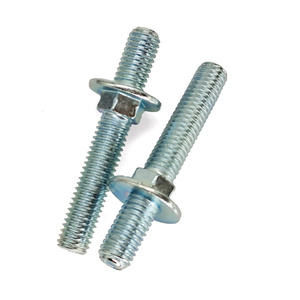
Naval shipbuilders in San Diego, Newport News, and offshore exploration hubs in Louisiana deploy our C51000 and C52100 heavy hex studs on saltwater manifolds, submerged valve bodies, heat exchangers, and seawater intake pumps where galvanic corrosion must be prevented.
For HV transformer substations in Texas and utility providers in the Midwest, electrical conductivity combined with mechanical spring yield makes phosphor bronze terminal bolts, split bolts, and busbar fasteners the gold standard for high-amperage junction stability without joint creep.
Precision lithography tools in California's Silicon Valley and Arizona semiconductor foundries rely on vacuum-annealed C54400 turned screws. The material generates zero magnetic interference, outgasses minimally, and resists abrasion inside clean automated handling pods.
Unlike carbon steels that turn brittle below zero, phosphor bronze maintains its fracture toughness and impact properties at temperatures below -196°C, securing liquid nitrogen (LN2) and LNG storage vessels across US transport terminals.
Strategic purchasing managers across the United States are adjusting their inventory methodologies to protect production lines against price volatility, geopolitical shifts, and updated quality regulations.
US procurement teams are supplementing local tier-1 fastener stockists with qualified Chinese manufacturers. Sourcing direct for repetitive runs provides 30–45% direct unit savings, helping offset US domestic machining backlogs.
Under strict aerospace, nuclear, and naval regulations, basic commercial invoices no longer suffice. US buyers now require full EN 10204 3.1 Mill Test Certificates detailing specific spectrometry results, proof load testing, and dimensional data per batch.
With US states introducing stricter environmental regulations on lead leaching in drinking water systems and marine ecology, demand is growing for compliant low-lead phosphor bronze formulations that preserve high-speed machinability.
We blend large-scale forging capacity with multi-axis precision machining, offering reliable quality, traceable testing, and direct factory pricing for export.
Every ingot is verified via optical emission spectrometers prior to cold heading or CNC turning. We track material heats from melting through final packing, eliminating counterfeit or out-of-spec deliveries.
Thread profiles are cold-rolled rather than single-point cut wherever possible, preserving continuous grain flow, enhancing thread fatigue endurance, and providing high root shear strength across all sizes.
Specialized export crating, vapor-corrosion-inhibiting (VCI) linings, and custom labeling support smooth transit into key US ports including Los Angeles/Long Beach, Houston, Savannah, and Newark.
Practical information for US engineers, supply officers, and logistics teams planning phosphor bronze purchases.
We routinely produce unified threads to ANSI/ASME B1.1, including Unified National Coarse (UNC), Unified National Fine (UNF), and 8-UN constant pitch profiles across Class 2A and 3A external fits, as well as metric coarse and fine standards (ISO 68-1 / 965).
Yes. Every shipment includes certified Mill Test Reports (MTR) covering chemical composition, yield strength, ultimate tensile strength, elongation percentage, and hardness testing directly linked to the batch heat number stamped on our packaging.
Fasteners are cleaned, treated with dry-lubricant anti-oxidation agents, sealed inside moisture-barrier bags with desiccant packs, and packed into reinforced corrugated boxes palletized onto heat-treated ISPM-15 export-compliant wooden crates.
Silicon bronze (e.g., C65500) provides slightly higher tensile properties for heavy marine timber and marine hardware. Phosphor bronze offers superior spring properties, greater fatigue endurance, and lower sliding friction—ideal for dynamic mechanical fastenings, spring washers, and electrical connections.
Yes. Our CNC facility produces custom shoulder screws, slotted guide pins, large-diameter flange bolts, and specialty lock nuts from customer-provided PDF, STEP, DWG, or IGES files within tight tolerances (±0.01mm).
Standard lead times range from 15 to 30 days depending on tooling and raw material readiness. We support standard shipping arrangements, including FOB, CIF, DDP, or direct coordination with your nominated US freight forwarder.
Submit your required bill of materials, alloy grades, thread specifications, or engineered drawings. We deliver detailed, transparent quotes alongside sample testing arrangements.