Conforming to DIN, ISO, and ASTM requirements, our precision-stamped and forged locking components support heavy-duty bolting assemblies across petrochemical, marine, and power facilities.
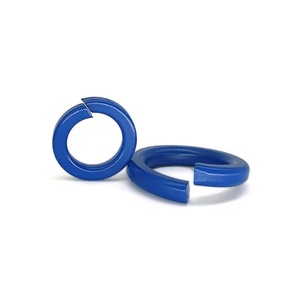
In high-vibration environments, bolted assemblies are subject to dynamic transverse shear stresses that initiate self-loosening via relative micro-motion at the contact threads. In mechanical installations across Bilbao, Catalonia, and the Andalusia industrial corridors, engineering specifications have evolved beyond standard friction-dependent spring washers toward positive mechanical wedge-locking principles (DIN 25201) and specialized high-elastic spring components (DIN 127B, DIN 6798).
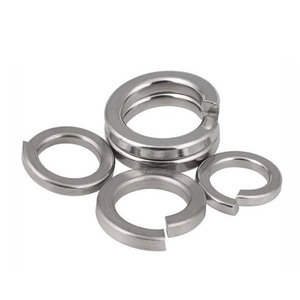
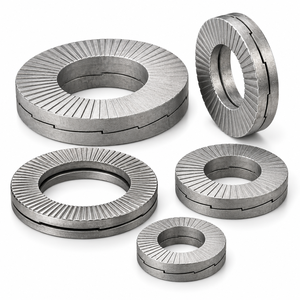
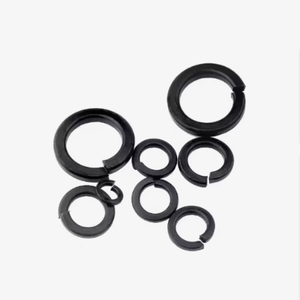
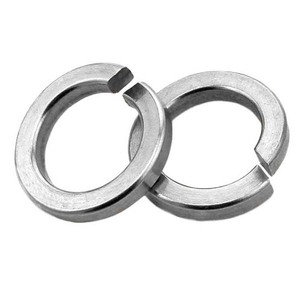
Standard helical spring lock washers function by applying continuous axial tension through elastic deflection, compensating for slight thermal expansion or gasket creep. However, for critical cyclic load environments—such as marine gas turbines in Ferrol or high-speed rail bogies on the ADIF AVE network—the spring force alone cannot withstand rotational back-off if the friction coefficient drops. Wedge-lock double-stack washer pairs utilize geometry rather than friction: the cam angle (α) between the washer faces is greater than the thread pitch (β), making unseating impossible without increasing pretension. As an established direct manufacturing and exporting partner, we verify Junker vibration performance according to DIN 65151 standards to certify zero-loosening under continuous multi-axis loads.
From offshore regasification terminals to aerospace and automotive manufacturing hubs, our lock washer lines are built to fulfill the mechanical integrity standards required by Iberian operators.
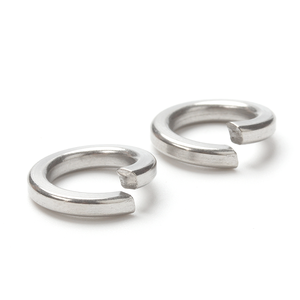
Spain houses some of Europe’s largest LNG regasification complexes (Huelva, Barcelona, Cartagena, and Bilbao). High marine salinity paired with cryogenic to high-pressure thermal cycling causes galvanic corrosion and thread seizure. We supply PTFE/Xylan-coated alloy washers, A4-80 (AISI 316) marine-grade split lock washers, and specialized duplex alloys to guarantee continuous preload retention on flanged piping joints without stress corrosion cracking.
With Spain holding over 30 GW of installed wind capacity, wind farm nacelles and tower flanges across Galicia, Castilla y León, and Aragon face constant turbulent harmonic vibrations. DIN 25201 double-stack wedge lock washers and zinc-flake coated spring washers prevent structural bolt loosening across yaw mechanisms, rotor blade attachments, and solar tracker articulating joints subject to continuous gusts.
Spain boasts Europe’s most extensive high-speed railway grid. Rail switches, signaling apparatus, track fastening assemblies, and undercarriage bogies require lock washers with exceptional fatigue limits. Our carbon steel quenched and tempered spring washers and stainless DIN 127B washers maintain specified bolt preloads against relentless dynamic shock waves and multi-axial wheel-rail impact pulses.
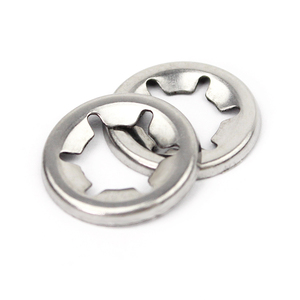
As the second largest carmaker in Europe, Spain’s production corridors (Valladolid, Vigo, Martorell, and Valencia) require tier-level fastener traceability. Internal and external tooth star washers (DIN 6798 A/J) provide ground bonding and secondary anti-loosening on sheet-metal electrical grounds, brake brackets, and exhaust heat-shield mountings where low clamping profile and anti-rotational bite are required.
In the shipyards of Navantia (Cádiz, Ferrol, Cartagena), marine power trains, rudder linkages, and seawater pump impellers require specialized non-ferrous and austenitic locking elements. We engineer Phosphor Bronze, Silicon Bronze, and A4-80 stainless washers that actively resist chloride-induced crevice corrosion and pitting while sustaining joint rigidity under propeller torque dynamics.
Across the chemical poles of Tarragona and Huelva, corrosive acids, hot solvents, and cyclic autoclaves require sealing-locking assemblies that avoid elastomer degradation. Custom fluoropolymer and PTFE-lined split lock washers eliminate galvanic corrosion when coupling dissimilar metals, preventing micro-leakages on high-pressure reactor manways.
Strategic changes across the European regulatory landscape, energy transitions, and supply chain reshoring determine how Spanish procurement directors source industrial locking hardware.
Under strict EU REACH and RoHS environmental mandates, electro-galvanization containing hexavalent chrome (CrVI) is strictly banned. Spanish manufacturers demand non-electrolytic zinc flake coatings (such as Geomet, Dacromet, or Delta-Protekt) and PTFE Xylan finishes. These barrier layers provide over 1,000 to 1,500 hours of neutral salt spray resistance (ASTM B117) without causing hydrogen embrittlement in high-tensile spring steel.
In rail and renewable installations, maintenance downtime accounts for up to 35% of operational budgets. As a result, engineering project tenders in Madrid, Valencia, and the Basque Country explicitly specify pre-assembled double-stack wedge lock washers conforming to DIN 25201. The mechanical cam action minimizes maintenance retorquing intervals, offering measurable total cost of ownership (TCO) reductions.
With the implementation of the EU Carbon Border Adjustment Mechanism (CBAM) and strict enforcement of the Pressure Equipment Directive (PED 2014/68/EU), Spanish importers require heat-traceable EN 10204 3.1 certification. Every production lot must be backed by documented chemical spectrographic analysis, hardness tests, and spring rate deflection curve validation.
Founded in 2010 in Mumbai, Viha Steel & Forging has matured into a globally recognized manufacturer and exporter of pressure equipment-certified industrial fasteners, high-tensile studs, pipe flanges, and lock washers. As an active member of the Fastener Manufacturers Association of India (FMAI), we bridge metallurgical consistency with world-class logistics for European importers.
Benchmark mechanical ratings, metallurgical compositions, and international standards across our primary lock washer product series.
Direct technical answers addressing customs protocols, international testing conformity, surface finishes, and Iberian delivery schedules.
Yes. Viha Steel & Forging is fully PED certified. When lock washers or companion bolting products are intended for pressure-retaining flanged joints in refineries, offshore rigs, or power plants across Spain, full material compliance is verified, preventing non-conformance during plant audits by bodies such as Lloyd's Register or TÜV Rheinland.
Every shipment bound for ports such as Valencia, Barcelona, Algeciras, or Bilbao includes complete EN 10204 Type 3.1 Mill Test Certificates traceable to the master heat number, third-party NDT inspection certificates, full coating thickness test data (magnetic and coulometric), and packing lists tailored for streamlined customs clearance via the Spanish Agencia Tributaria.
Electrolytic plating on high-hardness spring steels (over 320 HV) carries risk of atomic hydrogen entrapment. For Spanish clients specifying high-tensile lock washers, we utilize non-electrolytic zinc flake coatings (DIN EN ISO 10683) or execute de-embrittlement baking at 200°C–220°C within 4 hours of pickling or electro-deposition, followed by stress durability proof tests.
Yes. Beyond standardized DIN 127, DIN 128, DIN 6798, and DIN 25201 ranges, our stamping tooling and cold-forming presses support custom outer/inner diameters and thicknesses. Metallurgical options include high-performance Hastelloy, Monel 400, Inconel 718, 254 SMO, Phosphor Bronze, and Silicon Bronze for extreme marine and chemical installations.
Standard DIN catalogue items are dispatched from ready stock within 7 business days, while engineered stamping or specialty-coated batches typically ship within 3 to 4 weeks. All goods are packed in heavy-duty poly-lined cartons, securely palletized on fumigated ISPM-15 wooden pallets, shrink-wrapped, and edge-protected to prevent maritime moisture ingress during transit.
A standard spring washer relies solely on frictional resistance generated by spring tension. In contrast, DIN 25201 wedge-lock washer pairs have cams on the inside faces and radial teeth on the outside. When tightened, the external teeth grip the mating surfaces. The cam angle is steeper than the bolt thread pitch, so any loosening rotation increases clamp load, mechanically blocking unseating under extreme transverse vibration.
Consult with our metallurgical and fastener engineering specialists. We deliver verifiable MTC 3.1 certification, complete dimensional verification, and direct factory pricing on every export batch.
Get a Quote