
Integrated Butt-Weld Pipe Reducers, Pressure Flanges, and High-Tensile Structural Fastener Systems verified under stringent ISO 9001:2015 and European pressure vessel directives.
In modern German industrial engineering—spanning petrochemical complexes across North Rhine-Westphalia to pharmaceutical utilities in Baden-Württemberg—fluid conveyance systems operate under rigorous thermodynamic constraints. Butt-weld pipe reducers (Rohrreduzierstücke) act as hydraulic bridges between piping systems of disparate nominal diameters (DN). While seemingly straightforward, pipe reducers alter fluid velocity profiles, produce boundary-layer wall shear stress, and induce localized mechanical stresses that dictate overall line safety.
As an established OEM/ODM manufacturing partner, Viha Steel & Forging produces both Concentric Pipe Reducers (K-Red) and Eccentric Pipe Reducers (E-Red) compliant with harmonized European standards DIN EN 10253-2 (Carbon & Non-Alloy Steels) and DIN EN 10253-4 (Austenitic & Duplex Stainless Steels), alongside the traditional American standard ASME B16.9. Our manufacturing protocols address the core mechanical prerequisites demanded by German plant managers: full wall thickness endurance at the transition knick line, homogeneous grain structure free from micro-segregation, precise weld bevel geometries according to DIN 2559 / ISO 6761, and comprehensive conformity with the European Pressure Equipment Directive (PED 2014/68/EU Module H/H1).
Whether your project mandates low-temperature cold-formed P235GH / P265GH for district heating networks (Fernwärme), or high-purity electropolished 1.4404 (316L) reducers for chemical dosing skids, our OEM facilities support end-to-end metallurgical engineering, customized taper angle calculations, and turnkey batch testing.
Optimal selection between concentric (konzentrisch) and eccentric (exzentrisch) geometry is essential to eliminate vapor lock, pump cavitation, particulate accumulation, and thermal water hammer.
Designed with symmetrical cone profiles where the centerlines of both nominal diameters align perfectly along a common longitudinal axis. Used predominantly in vertical process flow lines, vertical vapor columns, and slurry lines where axisymmetric velocity distributions prevent localized erosion and maintain homogeneous flow acceleration.
Engineered with one straight planar side and an offset reduction angle. Installed in horizontal suction lines entering centrifugal pumps (Kreiselpumpen). Maintaining a flat top surface prevents the gathering of non-condensable gas pockets and air bubble migration into the impeller, mitigating cavitation damage and premature pump failure.
Oriented horizontally with the coplanar edge positioned at the absolute invert of the piping run. Essential for horizontal steam pipelines, hydrocarbon condensation lines, and gravity drain systems. It guarantees zero pool damming, unimpeded condensate evacuation to steam traps, and prevents water-hammer-induced pipe ruptures.
Under DIN EN 10253 and ASME standards, excessive taper angles generate boundary layer separation and turbulence eddies. Viha calculates taper half-angles (α ≤ 15°) to stabilize fluid deceleration in diffuser orientations and minimize head loss across compressed natural gas, syngas, and cryogenic circuits.
| Design Parameter | Concentric Reducer (K-Red) | Eccentric Flat-on-Top (FOT) | Eccentric Flat-on-Bottom (FOB) |
|---|---|---|---|
| Primary Orientation | Vertical flow lines / Manifold headers | Horizontal centrifugal pump suction | Horizontal steam / Sludge drainage |
| Aerodynamic Cavitation Risk | Moderate in horizontal pump intake | Zero Risk (Gas bubbles self-purge) | High if installed in suction pipelines |
| Condensate Stagnation | Pools at bottom lip in horizontal layout | Creates bottom lip trap for condensates | Zero Stagnation (Continuous drainage) |
| Stress Distribution Profile | Uniform axisymmetric hoop stress | Asymmetrical bending moment across flat zone | Asymmetrical hoop & thermal expansion shear |
| Common Material Grades | P235GH, P265GH, 1.4404, WPB, 316L | 1.4404 (316L), 1.4571 (316Ti), Duplex 1.4462 | 16Mo3, 13CrMo4-5, ASTM A335 P11/P22 |
From the Rhine-Ruhr chemical cluster to LNG storage regasification terminals in the North Sea, our OEM/ODM custom pipe reducers satisfy the stringent operating envelopes of German industry.
In major German chemical parks such as Chemiepark Leverkusen, Industriepark Höchst (Frankfurt), and BASF Ludwigshafen, pipe reducers handle aggressive sulfuric acids, chlor-alkali solutions, and high-temperature hydrocarbon cracking. Our ODM production provides custom pickling, passivating, and inside electropolishing (Ra < 0.4 μm) for high-alloy stainless steels (1.4404, 1.4571 / 316Ti, and Alloy C22). Every reducer features traceable melt chemistry conforming strictly to maximum cobalt, carbon, and ferrite content specifications to prevent stress corrosion cracking (SCC) under cyclic thermal loads.
German municipal utilities (Stadtwerke) across Berlin, Munich, and Hamburg are retrofitting central district heating networks for low-carbon hot water transport under the Gesetz für die Wärmeplanung. Reducers deployed underground require seamless cold-forged P235GH / P265GH construction with pre-insulated polyurethane casing capabilities. Our factory produces tight tolerance, normalized butt-weld ends optimized for automated orbital GTAW welding, eliminating root pass offsets and ensuring fifty-year maintenance-free service under continuous thermal expansion cycles.
With the rapid rollout of floating and land-based LNG import infrastructure (Wilhelmshaven, Brunsbüttel, Stade) and the construction of the German Wasserstoff-Kernnetz (9,700 km Hydrogen Core Network), piping fittings must maintain high Charpy V-Notch impact values at -196°C. We supply low-temperature alloy reducers in ASTM A420 WPL6 and 1.4306/1.4404 with documented cryogenic impact tests at -196°C exceeding 40 Joules, alongside low-carbon microstructures proven to resist hydrogen embrittlement.
German automotive manufacturers in Bavaria and Lower Saxony rely on stainless steel concentric reducers for centralized paint recirculating systems and high-pressure robotic wash systems. Reducers must remain 100% free of silicone, grease, and weld spatters (LABS-frei nach VDMA 24364). Our ultrasonic wash stations and clean-room packaging guarantee zero contaminant carryover into automated robotic paint lines.
Specialized machine builders in Baden-Württemberg demand heavy-wall custom OEM reducers with heavy CNC machining allowances. We engineer heavy-forged reducers designed for hydraulic power units, plastic extrusion plants, and steam turbines operating up to 450 bar, complete with integral sensor bosses, non-destructive magnetic particle inspection, and ultrasonic wall thickness scans.
Procurement in Germany is characterized by zero-tolerance quality gates. Understand how our supply processes fulfill the technical mandates of TÜV, DEKRA, and statutory environmental legislation.
All pipe reducers shipped into the Federal Republic of Germany conform to the European Pressure Equipment Directive (PED). Our quality management infrastructure is certified under AD 2000-Merkblatt W0 / HP0, authorizing our metallurgical labs to issue EN 10204 3.1 material test certificates verified against pressure calculation tables.
For safety-critical chemical reactors and offshore installations, we collaborate with third-party inspection authorities (TÜV Rheinland, TÜV SÜD, DNV, Bureau Veritas). Inspectors audit our heat treatment cycles, witness raw tensile pulls, and stamp final EN 10204 3.2 documentation before maritime shipping.
In alignment with the German Lieferkettensorgfaltspflichtengesetz and the EU Carbon Border Adjustment Mechanism (CBAM), we provide documented scope 1 & 2 embedded carbon emissions per metric ton of steel fittings, alongside ESG human rights auditable certification.
| German Material No. (Werkstoff) | EN Designation (DIN EN 10253) | US Equivalent (ASTM / ASME) | Yield Strength Min. (MPa) | Operating Temperature Range |
|---|---|---|---|---|
| 1.0345 | P235GH | ASTM A234 WPB / A106 Gr. B | 235 | -10°C to +400°C (Steam / Utility) |
| 1.0425 | P265GH | ASTM A234 WPB / WPC | 265 | -10°C to +450°C (Boilers & Heating) |
| 1.0566 | P355NL1 | ASTM A420 WPL6 | 355 | -50°C to +350°C (Low-Temp Gas) |
| 1.4301 / 1.4307 | X5CrNi18-10 / X2CrNi18-9 | ASTM A403 WP304 / 304L | 205 / 175 | -196°C to +550°C (Food & Pure Media) |
| 1.4404 / 1.4435 | X2CrNiMo17-12-2 | ASTM A403 WP316L | 220 | -196°C to +600°C (Chloride / Chemical) |
| 1.4571 | X6CrNiMoTi17-12-2 | ASTM A403 WP316Ti | 220 | -10°C to +550°C (Titanium-Stabilized Acid) |
| 1.4462 | X2CrNiMoN22-5-3 (Duplex) | ASTM A815 S31803 / S32205 | 450 | -40°C to +250°C (Offshore / High Saline) |
Established in 2010 in Mumbai, India, Viha Steel & Forging has matured into an internationally acclaimed manufacturing powerhouse. As an active member of the Fastener Manufacturers Association of India (FMAI) and holding direct European PED approval, we combine deep forging engineering capabilities with precision CNC machining to supply both standard catalogue fittings and custom high-alloy pipe reducers worldwide.
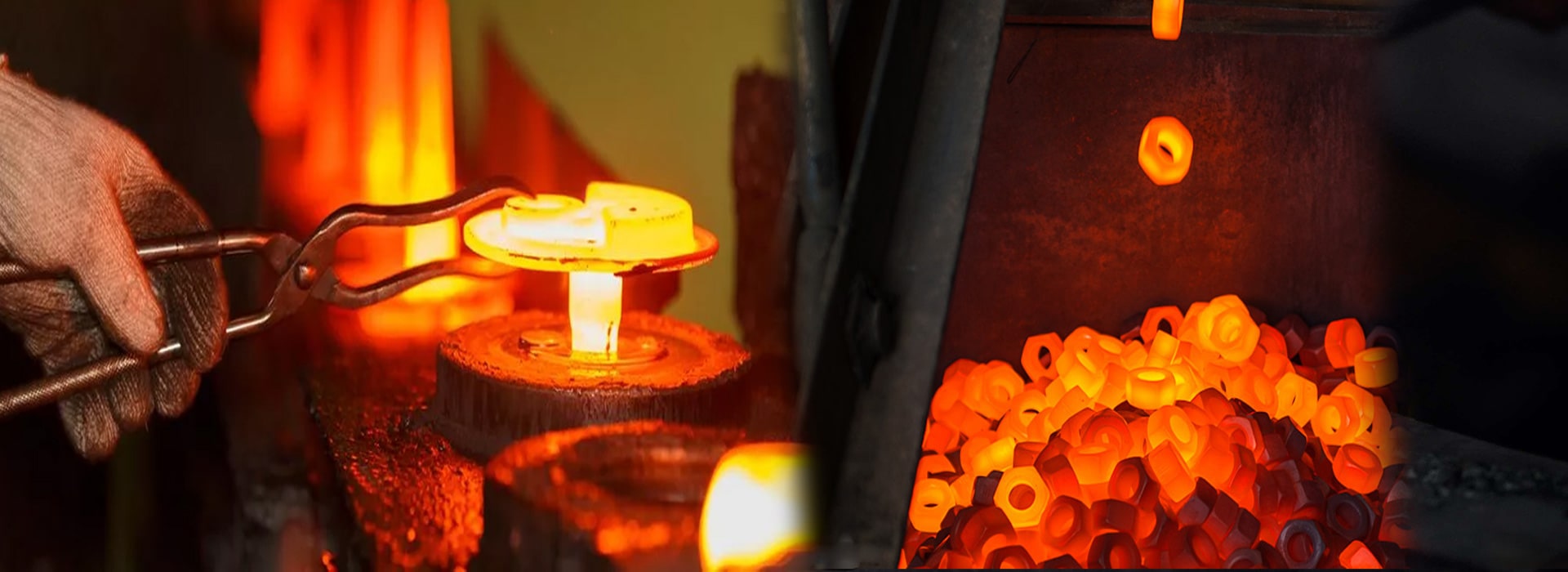
Unlike trading brokers, Viha controls every step in-house: from sourcing scrap-monitored vacuum-degassed round bars to precision hot/cold mandrel forming, computer-controlled normalizing and solution annealing furnaces, CNC bevel turning, and automated pickling lines. Our factory is also recognized as one of India's top 3 exporters of hot-dip galvanized and high-pressure alloy components, regularly servicing large-scale infrastructure projects across Western Europe, the Middle East, and the Americas.
Optical emission spectrometer (OES) assays verify Carbon, Silicon, Manganese, Phosphor, Sulfur, Chromium, Nickel, and Molybdenum levels per heat prior to cutting.
Continuous electric heating furnaces deliver isothermal normalizing for P235GH/P265GH and rapid water quenching (>1050°C) for stainless 1.4404 to stabilize carbides.
Ultrasonic testing (UT), Liquid Penetrant inspection (PT), and Magnetic Particle testing (MPI) carried out by certified ASNT / EN ISO 9712 Level II technicians.
Direct engineering answers addressing testing documentation, customs clearance, tolerances, and design standards for technical purchasers across Germany, Austria, and Switzerland (DACH).
Collaborate with Viha Steel & Forging for competitive OEM pricing, full DIN EN 10204 3.1 certification, and direct logistics to German ports and industrial sites. Upload your drawings or specification sheets today.