
Manufactured in full compliance with ISO 898-1, ASTM A193, ASTM A320, and DIN standards. Our studs feature rolled precision threading, certified metallurgy, and custom corrosion protection tailored for Gulf desert and offshore marine operations.
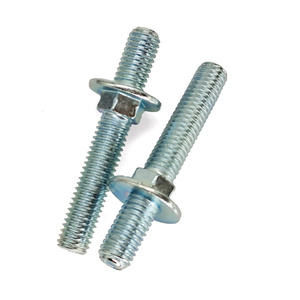
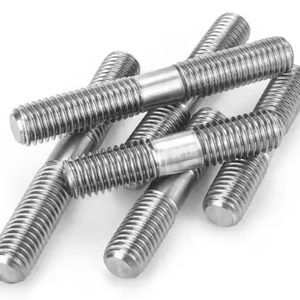
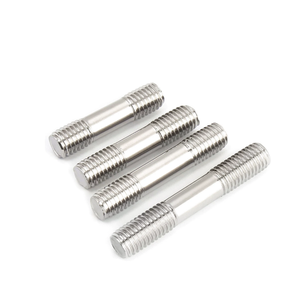
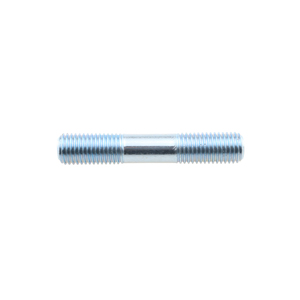
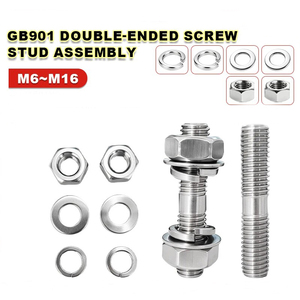
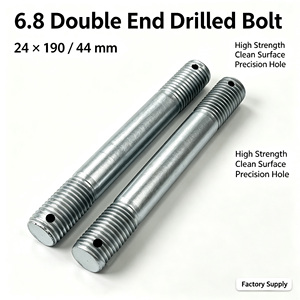
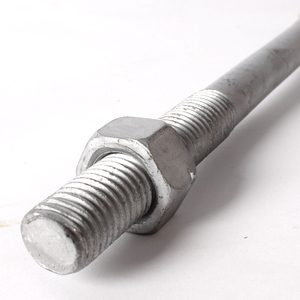
Double end stud bolts (also known as tap-end studs, clamping studs, or engineered double-sided threaded fasteners) serve as mission-critical anchoring elements in heavy petrochemical, energy, and marine civil engineering. Unlike standard continuous threaded rods (DIN 975/976), double end studs feature an unthreaded shank (waist) engineered to specific length tolerances per DIN 938 (tap end ~1d), DIN 939 (tap end ~1.25d), or DIN 940 (tap end ~2.5d). This specialized geometry eliminates stress concentration across structural shear planes, optimizes elasticity during high cyclic thermal expansion, and guarantees predictable clamping torque in pressure-retaining casings.
In the Kingdom of Saudi Arabia (KSA), mechanical hardware operates under one of the planet's most aggressive convergence zones: ambient surface temperatures regularly exceeding 52°C (125°F), airborne sand abrasive erosion, extreme ultraviolet exposure, and high chloride/sulfate deposition along the Arabian Gulf and Red Sea shorelines. Specifying high-integrity double end studs requires comprehensive metallurgical mastery, ranging from quenched and tempered alloy steels to high-purity austenitic and nickel superalloys tested strictly under sour gas (H2S) cracking thresholds.
To eliminate procurement ambiguities for Aramco, SABIC, and SWCC contractor consortia, the table below highlights standard engineering chemistries, mechanical minimums, and standard coating integrations utilized across KSA installations:
| Standard & Grade | Base Metallurgy | Tensile Min. (MPa / ksi) | Yield Min. (MPa / ksi) | Applicable Surface Treatment | Target KSA Application Area |
|---|---|---|---|---|---|
| ASTM A193 Gr. B7 | AISI 4140/4142 Chromium-Molybdenum | 860 MPa / 125 ksi | 720 MPa / 105 ksi | Hot Dip Galv (ASTM A153) / PTFE Xylan | Refinery High-Pressure Piping & Flanges |
| ASTM A193 Gr. B7M | Controlled Cr-Mo (Hardness 22 HRC max) | 690 MPa / 100 ksi | 550 MPa / 80 ksi | Fluoropolymer Ceramic / Zinc-Nickel | NACE MR0175 / ISO 15156 Sour Gas Lines |
| ASTM A193 Gr. B8 Cl.2 | AISI 304 Stainless (Strain Hardened) | 860 MPa / 125 ksi | 690 MPa / 100 ksi | Passivated / MoS2 Anti-Galling | Cryogenic LNG Terminals & Valve Bonnet |
| ASTM A193 Gr. B8M Cl.2 | AISI 316 Molybdenum-Bearing Stainless | 760 MPa / 110 ksi | 655 MPa / 95 ksi | Electro-Chemical Passivation / Xylan 1070 | SWCC Desalination Sea Intake Manifolds |
| ISO 898-1 Class 8.8 / 10.9 | Boron / Carbon-Manganese Quenched Steel | 800 / 1040 MPa | 640 / 940 MPa | Hot Dip Galvanized / Blue Zinc Trivalent | NEOM Civil Foundations & SEC Crossarms |
Double end stud bolts exported from our high-precision production facilities are deployed across three primary physical and mechanical environments throughout Saudi Arabia:
Installed on heat exchanger channel heads, heavy centrifugal split-case pump flanges, and reactor vessels. Tap ends are screwed securely into cast iron or cast steel pump bodies, while the exposed nut end accommodates ASME B16.5 heavy hex nuts, facilitating repeated MRO unbolting without stripping internal engine casing threads.
Thermal Multi-Stage Flash (MSF) and Reverse Osmosis (RO) plants demand ASTM A193 B8M or Duplex 2205 double end studs. The bare central shank prevents salt crystallization within inactive threads, while PTFE/Fluoropolymer (Xylan 1070) barrier layers stop crevice corrosion under intense hyper-saline desert heat.
Employed in precast concrete structural joints, high-speed rail gantry tie-backs, and SEC crossarm pole assemblies. Hot Dip Galvanized Class 8.8 and ASTM A193 B7 studs provide heavy-duty shear absorption and fatigue resistance against persistent high desert wind vortices and cyclic thermal expansion loads.
Driven by Saudi Arabia's Vision 2030 economic transformation, procurement paradigms in the Kingdom have evolved significantly over the past five years. International EPC contractors executing lump-sum turnkey (LSTK) contracts for Saudi Aramco, Air Products, ACWA Power, and NEOM face rigid technical compliance mandates. Successful Chinese exporters are no longer purely low-cost providers; they must act as deeply compliant engineering partners capable of supporting technical submittals, vendor qualification portals, and third-party inspection certifications.
Three overarching procurement megatrends dictate successful fastener importation into Saudi Arabia today:
1. Stringent Mandates for Sour Service & Crack Resistance: With the development of the Jafurah unconventional gas field and expanded deep sour gas recovery programs, demand for NACE MR0175/ISO 15156 compliant double end studs has surged. Exporters must prove precise heat treatment quenching and tempering cycles to keep bulk hardness below 22 HRC while maintaining minimum tensile strength thresholds of 100 ksi, eliminating catastrophic Hydrogen-Induced Cracking (HIC) and Sulfide Stress Corrosion (SSC).
2. Shift toward Long-Life Barrier Coatings over Standard Cadmium: Environmental and chemical performance restrictions have prompted major Saudi asset owners to outlaw conventional toxic electro-cadmium coatings. The dominant specifications in the Gulf now stipulate multi-layer thermosetting PTFE coatings (such as Xylan 1070/1014 or Whitford coatings over zinc-nickel or phosphate pretreatments). These systems deliver up to 3,000–5,000 hours of ASTM B117 salt spray neutral fog resistance, completely resisting coastal marine humidity.
3. Supply Chain Agility vs. IKTVA Integration: While Saudi Arabia actively drives local value creation through the In-Kingdom Total Value Add (IKTVA) program, severe capacity deficits remain for specialized heavy-diameter double end studs (M36 through M100) and precision stainless/exotic alloys. Tier-1 engineering contractors bridge this gap by establishing direct, audited supply agreements with leading Chinese manufacturing exporters that provide end-to-end Mill Test Certificate (MTC) traceability directly linked to molten heat numbers.
Originating from established forged steel and industrial fastener roots since 2010, our manufacturing infrastructure combines heavy forging power with high-precision CNC thread rolling and automated heat-treatment furnaces. As a PED (Pressure Equipment Directive) certified manufacturer and member of the Fastener Manufacturers Association, our export department is fine-tuned to deliver seamless compliance for Saudi Arabia.
State-of-the-art cold heading and hot forging production headers capable of producing double end studs from micro-precision M2 instrumentation sizes up to massive M100 (4-inch) heavy flange studding.
Fully compliant with European Pressure Equipment Directive (PED 2014/68/EU) and ISO 9001:2015. Every manufacturing run follows documented ITP (Inspection & Test Plans) approved for international pressure vessel bolting.
Every shipment ships accompanied by EN 10204 Type 3.1 Mill Test Certificates detailing optical emission spectrometry (OES) chemical breakdowns, tensile, yield, elongation, reduction of area, and Charpy V-notch impact values.
Thread grain flows remain unsevered via cold and hot thread rolling, ensuring 30% higher fatigue life than cut threads. Non-Destructive Testing (NDT) includes 100% Magnetic Particle (MPI) and Ultrasonic testing upon project request.
We are fully integrated with the Saudi Product Safety Program (SALEEM) via the SABER online portal. For each shipment, we supply accredited third-party laboratory test reports to obtain the mandatory Product Certificate of Conformity (PCoC) and Shipment Certificate of Conformity (SCoC) via SASO-notified certification bodies, ensuring zero customs holds at King Abdulaziz Port (Dammam) or Jeddah Islamic Port.
The difference lies strictly in the length of the tap end (metal engagement end). DIN 938 features a tap end equal to approximately 1.0 × stud diameter (1d), intended for threading into steel and bronze casings. DIN 939 has an engagement length of 1.25d, optimal for grey iron and cast iron. DIN 940 specifies a 2.5d engagement length, engineered for lower-strength light aluminum alloys and non-ferrous soft base materials.
Yes. In strict compliance with ASTM A193 and NACE MR0175/ISO 15156, our B7M studs receive complete furnace heat-treatment record logging. We provide 100% automated non-destructive hardness testing across the entire production batch to ensure no single stud exceeds 22 HRC (237 HBW), preventing catastrophic sulfide stress cracking during critical sour gas handling.
Hot-dip galvanizing (per ASTM A153 Class C or ISO 10684) deposits a heavy protective zinc layer of 45–65 μm. To prevent mechanical binding while preserving bolt core shear load integrity, we either undercut the stud pitch diameter prior to zinc immersion or supply matching ASTM A194 2H heavy hex nuts tapped oversize (per ASTM A563 overtapping tables) to deliver a precision fit.
To prevent humidity moisture condensation during maritime shipping through the Indian Ocean and Red Sea, our export studs undergo automated anti-rust vapor phase inhibition (VCI) oil dipping, followed by inner polyethylene moisture-proof wrapping, heavy reinforced cartons (max 25 kg), and heat-treated ISPM-15 compliant solid fumigated wooden pallets banded with steel strapping.
Standard metric and imperial stud diameters (such as M12–M36 or 1/2"–1-1/2" in ASTM A193 B7 and SS304/SS316) are maintained in semi-finished unthreaded bar stock, allowing fast dispatch within 7–10 days. Custom alloy compositions or specialized fluoropolymer PTFE coatings generally require 20–25 days production. Ocean transit from Ningbo/Shanghai to Dammam or Jeddah is approximately 18–24 days.
Connect directly with our senior fastener application engineering group. Send us your project bill of quantities (BOQ), material specifications (ASTM, DIN, ISO, NACE), thread pitch standards, and required coatings to receive a fast, competitive quotation with complete MTC verification documentation.